
Phone

What Is Tortious Interference in Florida Business Law?

What to Expect in a Florida Commercial Lease Dispute

Florida Non-Compete Agreements: When Are They Enforceable?

How Florida Mediation Saves You Time and Money in Business Disputes

What to Do When a Business Partner Breaches a Contract in Florida

How Mediation Works in Florida Real Estate Disputes

Resolve Construction Contract Disputes In South Florida

Real Estate Attorney Fort Lauderdale: Why Experience Matters for Your Property

Las Olas Breach of Contract Attorney

Your Insider Guide To South Florida Real Estate Contract Disputes

Call Now Email12
Florida's Business Law Firm
Fort Lauderdale Phone954-767-9662

What Is Tortious Interference in Florida Business Law?

Florida tortious interference — business litigation attorney

If a competitor is spreading false information about your business, a former partner is contacting your clients to steer them away, or someone pressured your supplier to cut off your contract — you’re probably experiencing what Florida law calls tortious interference. Tortious interference in Florida is a business tort that holds third parties liable when they deliberately disrupt your contracts or business relationships. It’s one of the most useful tools Florida business owners have against bad actors who operate just outside of direct breach of contract — but it has specific elements you have to prove.

The Two Types of Tortious Interference Florida Recognizes

Interference with an Existing ContractFlorida tortious interference — business litigation attorney

This is the cleaner claim. You had a valid, enforceable contract with a third party. The defendant knew about it. They intentionally caused the other party to breach it. You suffered damages as a result. When all four line up, you have a strong Florida tortious interference claim. Courts don’t require you to prove the defendant used improper means — intentional interference with a known contract is enough.

Interference with a Prospective Business Relationship

This is harder to prove, but it covers situations where there was no signed contract yet — just a deal that was moving toward closing, a customer relationship that was ongoing, or a business opportunity that was being developed. Here, Florida courts require you to show the defendant’s conduct was improper — not just that they competed aggressively. Courts look at the defendant’s motive, the methods used, and whether those methods cross ethical or legal lines. A Florida business litigation attorney can help you assess which version of the claim you’re working with.

What You Have to Prove — Element by Element

The Full Checklist

Element What It Means for Your Case
Existence of a contract or relationship A valid contract or a specific, identifiable business relationship — not just general goodwill
Defendant’s knowledge They knew the contract or relationship existed — this is usually not hard to prove in business contexts
Intentional interference They acted deliberately — negligent interference doesn’t count in Florida
Causation Their interference actually caused the contract to be breached or the relationship to end
Damages You suffered real, quantifiable economic harm — lost contracts, lost revenue, lost customers

The Evidence That Usually Makes or Breaks It

The causation element is where most Florida tortious interference claims succeed or fail. You need to show the defendant’s actions — not some other factor — were the reason the business relationship ended. Email communications, text messages, testimony from the third party about what they were told, and timing evidence are all critical. Start preserving everything now if you suspect interference is happening.

Real Examples of Tortious Interference in Florida Business DisputesFlorida business litigation attorney fees — fee agreement review

Patterns That Show Up Most Often

  • A competitor contacts your key clients and tells them — falsely — that your company is going out of business or facing legal trouble
  • A former business partner reaches out to your supplier and convinces them to breach their supply agreement with you
  • An investor provides false information to the other party in a deal you were about to close, causing them to walk away
  • A former employee violates their non-solicitation agreement by contacting your customer list and actively steering clients to their new employer
  • A third party pressures a joint venture partner to withdraw from a signed agreement

The Competition Privilege — Their Main Defense

What It Covers

Not everything that hurts your business is tortious interference. Florida recognizes the competition privilege — the right to compete fairly for business, even aggressively. Winning a contract away from a competitor through better pricing, faster service, or a better product is not tortious interference. The line is drawn at improper means: false statements, threats, misuse of confidential information, or conduct that violates independent legal standards. Expect this defense in any Florida business tort case.

What Doesn’t Get the Competition Privilege

  • Spreading false information about a competitor’s business
  • Using confidential information obtained from the competitor’s former employees
  • Making threats or using economic coercion to pressure a third party to breach
  • Inducing breach of a known contract — not just winning business away from one

Courts look at the totality of conduct. One aggressive move might get the privilege; a pattern of coordinated interference usually doesn’t. See the Cornell Law overview of tortious interference for the national legal framework and how Florida fits within it.

What Damages Are Available

Damage Type Description
Lost profits Revenue from the specific contract or relationship that was disrupted
Consequential business losses Downstream effects — lost follow-on business, reputational harm with measurable impact
Punitive damages Available when conduct was intentional and particularly egregious — requires clear and convincing evidence of malice

Frequently Asked Questions

Question Answer
Can I sue a competitor for tortious interference in Florida? Yes — if they used improper means, not just aggressive competition. The key is whether they crossed from competing into interfering.
Do I need a written contract? No. Florida protects prospective business relationships that haven’t produced a signed contract yet — though the claim is harder to prove.
How quickly should I act? Immediately. Evidence disappears, witnesses’ memories fade, and the four-year statute of limitations starts running from the date of interference — not when you discovered it.

Someone Crossed the Line — Florida Law Gives You a Path Forward

If a competitor or third party has deliberately disrupted your Florida business relationships, Feinstein Law handles tortious interference claims and Florida business litigation throughout South Florida. Call (954) 767-9662 or reach us at our contact page.

About Feinstein Law: Feinstein Law is a Fort Lauderdale firm handling commercial disputes, contract claims, and real estate litigation throughout Broward, Miami-Dade, and Palm Beach counties.

By : Michael Feinstein | April 14, 2026 | Business Litigation

What to Expect in a Florida Commercial Lease Dispute

Florida commercial lease dispute — attorney reviewing agreement

A Florida commercial lease dispute can go from a late payment or a maintenance argument to a full-blown eviction proceeding or six-figure damages claim faster than most business owners expect. Whether you’re a landlord who hasn’t received rent in 90 days or a tenant sitting in a space with a broken HVAC system your landlord refuses to fix, commercial lease disputes in Florida are driven almost entirely by what the written lease says — and most people don’t fully understand their lease until there’s already a problem. Here’s what you need to know before this gets worse.

Why Florida Commercial Leases Are Different from Residential

Far Fewer Tenant Protections

Florida’s residential landlord-tenant statute (Chapter 83, Part II) comes loaded with tenant rights. Commercial leases in Florida are governed by Chapter 83, Part I — which is much leaner. There’s no statutory requirement for a commercial landlord to return a security deposit within a set timeframe unless the lease says so. The implied warranty of habitability doesn’t apply the same way. The written agreement controls almost everything, which is why the specific language in your lease matters so much in a dispute.

The Three-Day Notice Requirement Still Applies

Before a commercial landlord can begin eviction proceedings for non-payment, Florida law still requires a three-day written notice to pay or vacate under § 83.20. That notice must be properly served and must comply with the exact statutory requirements — a defective notice can restart the clock and delay the entire eviction process.

The Most Common Commercial Lease Disputes in Florida

Non-Payment and Rent Disputes

This is the most common starting point. You’re probably dealing with a tenant who stopped paying, is paying partial rent, or is claiming a right to withhold rent because of conditions at the property. Landlords: document every missed payment and send your three-day notice correctly the first time — a procedural error means starting over. Tenants: check your lease for any abatement rights before you withhold rent unilaterally.

CAM and Operating Expense Reconciliation

Common Area Maintenance charges are a recurring source of Florida commercial lease disputes. Many tenants don’t scrutinize annual CAM reconciliations closely enough — and many landlords include expenses that aren’t actually permitted under the lease. A Florida contract dispute attorney can audit the reconciliation and identify overcharges that can often be recovered without litigation.

Early Termination and Buildout Disputes

You’re probably also facing one of these if things have gone sideways:

  • A tenant wants out before the lease ends and disputes the early termination penalty
  • A landlord failed to deliver promised tenant improvement allowances
  • A buildout has construction defects that the landlord refuses to repair
  • A subletting or assignment request the landlord is blocking without a legitimate reason

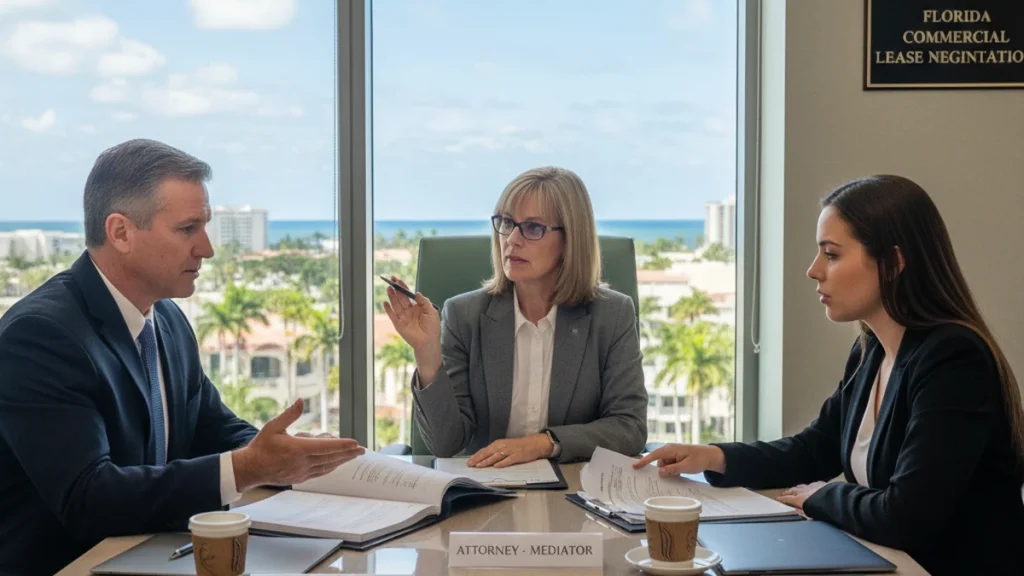
Florida commercial lease negotiation between landlord tenant and attorney

Commercial lease disputes often escalate to litigation when notice requirements are ignored.

What the Litigation Process Actually Looks Like

From Demand Letter to Trial

Stage What Happens Typical Timeline
Pre-suit demand Attorney sends formal demand citing the breach and demanding cure or payment Days 1–14
Filing & service Complaint filed in circuit court; defendant has 20 days to respond Weeks 2–4
Discovery Exchange of financials, lease communications, maintenance records Months 2–6
Mediation Florida courts typically require mediation before trial Months 4–8
Trial or settlement Most cases resolve at mediation; contested cases go to trial Months 6–18+

Self-Help Eviction Is Not Allowed

Some landlords think they can change the locks or remove a tenant’s property when rent goes unpaid. Self-help eviction is prohibited in Florida even if your lease purports to allow it. A landlord who locks out a commercial tenant without a court order can face significant liability. The right path is through the courts — and with a proper three-day notice, the process moves faster than most people expect. Review the full Florida landlord-tenant statute if you want to see exactly what’s permitted.

Attorney Fees — A Huge Factor in How These Cases Resolve

Prevailing Party Clauses Cut Both Ways

Most well-drafted commercial leases include a prevailing party attorney fee clause. Under Florida law, if a contract provides for fees to one party, it applies to both. That means if you lose, you pay the other side’s attorney fees — and if you win, you can recover yours. This dynamic changes how both sides evaluate settlement at every stage of a Florida business litigation case.

Frequently Asked Questions

Question Answer
Can my landlord lock me out of my commercial space in Florida? No. Self-help eviction is illegal in Florida regardless of what your lease says. The landlord must go through the court eviction process.
How long does a commercial eviction take in Florida? Uncontested evictions can wrap up in 4–6 weeks after proper notice. Contested cases can take several months.
What if our lease has no dispute resolution clause? Florida courts default to standard civil litigation procedures. Mediation may still be required by the court before trial.
Can I withhold rent if my landlord won’t make repairs? This is risky without specific lease language authorizing it. Consult an attorney before withholding rent — it can trigger eviction proceedings.

Stop Letting a Lease Dispute Drain Your Business

The longer a Florida commercial lease dispute goes unresolved, the more it costs both sides. Feinstein Law represents landlords and tenants in commercial lease litigation throughout Broward, Miami-Dade, and Palm Beach counties. Call (954) 767-9662 or contact us at our contact page.

About Feinstein Law: Feinstein Law is a Fort Lauderdale litigation firm handling business, real estate, and construction litigation throughout South Florida.

By : Michael Feinstein | April 9, 2026 | Commercial Real Estate

Florida Non-Compete Agreements: When Are They Enforceable?

Florida non-compete agreement review with business attorney

If you’ve been handed a Florida non-compete agreement to sign — or you’re an employer trying to enforce one — you need to understand something most people get wrong: Florida doesn’t treat these agreements the way almost every other state does. Florida non-compete agreements are explicitly authorized by statute, and courts here are required to enforce them when they’re reasonable. That means signing one carries real consequences. And fighting one is harder than you’d expect. Here’s what actually determines whether a Florida non-compete holds up in court.

What Florida Law Actually Says

The Statute Is Employer-Friendly by Design

Florida’s non-compete statute, § 542.335, is one of the most employer-favorable in the country. It requires courts to enforce non-compete agreements in Florida that protect a legitimate business interest and are reasonable in time, area, and scope. Courts cannot simply void an overly broad agreement — they are required by law to reform it, narrowing it to an enforceable version. That’s called blue-penciling, and it strongly favors employers.

What That Means If You’re an Employee

You can’t rely on a non-compete being thrown out just because it seems broad. A court may enforce a 2-year version of a 5-year agreement rather than toss it entirely. Before you take a new job at a competitor, talk to a Florida business litigation attorney who can read your specific agreement and tell you the real risk.

The Threshold Question: Is There a Legitimate Business Interest?

Without This, the Agreement Fails

This is the first thing any court evaluates. A Florida non-compete without a legitimate business interest behind it will not be enforced — period. Florida recognizes these as legitimate interests:

  • Trade secrets and confidential business information — formulas, client lists, pricing models, proprietary processes
  • Substantial customer relationships — clients the employee developed or had significant access to
  • Specialized training — extraordinary investment the employer made in the employee’s skill set
  • Business goodwill — tied to a geographic area or specific marketing territory

If none of those exist, the agreement has no anchor. That’s the argument an employee’s attorney will make first in any Florida contract dispute.

Florida attorney reviewing non-compete agreement with client

What Doesn’t Qualify

General knowledge of the industry, basic job skills, or relationships the employee brought to the company — not built while there — typically don’t qualify as legitimate business interests. The employer has to show the interest they’re protecting is genuinely theirs to protect.

Reasonableness: Time, Geography, and Scope

Time Periods Florida Courts Treat as Presumptively Reasonable

Restriction Period Context Florida Presumption
6 months or less Any employee Presumed reasonable
Up to 2 years Former employee, independent contractor Presumed reasonable
Up to 3 years Sale of business goodwill Presumed reasonable
More than 2 years Employee non-compete Faces heightened scrutiny

Geographic and Activity Scope

The restriction must tie to the actual area where the employer does business and the actual work the employee performed. A statewide non-compete for an employee who only worked in one city, or a ban on entire industries when the employee worked in one niche role, are both vulnerable to challenge — though again, courts may narrow rather than void.

Injunctions: Why Non-Compete Cases Move Fast

Employers Can Get an Emergency Order Within Days

When an employee violates a Florida non-compete agreement, employers typically don’t wait for trial — they go straight to court for a temporary injunction. Florida law presumes irreparable harm exists when a legitimate business interest is threatened. That means employers don’t need to prove actual financial damage to get an emergency order stopping the former employee from working for the competitor. This process can move in days, not months.

What This Means If You’re the Employee

If you’ve already started the new job, you could be ordered to stop immediately while litigation plays out. The cost — financially and professionally — can be severe. Don’t assume the agreement won’t be enforced because it “seems unreasonable.” Get legal advice before you make the move, not after. The FTC’s non-compete rulemaking has been blocked by federal courts as of 2026, so Florida’s employer-friendly statute still governs.

Frequently Asked Questions

Question Answer
Can Florida courts really rewrite my non-compete? Yes. Florida law requires courts to modify overbroad agreements rather than void them. This is a major difference from most states.
What if I was laid off — does the non-compete still apply? Generally yes in Florida unless the agreement says otherwise. Some courts consider whether the employer terminated without cause when evaluating enforceability, but it’s not an automatic defense.
Can I negotiate a non-compete before signing? Absolutely — and you should. Once signed, you’re bound by it. Push back on duration, geography, and scope before you put pen to paper.
Does Florida’s non-compete law apply to independent contractors? Yes. Florida § 542.335 covers employees, independent contractors, and business purchasers.

Whether You’re Enforcing or Escaping a Florida Non-Compete, Know Where You Stand

Florida’s law puts employees at a real disadvantage compared to most states. If you’re facing a Florida non-compete agreement — on either side — Feinstein Law can evaluate your position and tell you exactly what you’re up against. Call (954) 767-9662 or reach us at our contact page.

About Feinstein Law: Feinstein Law is a Fort Lauderdale litigation firm handling business disputes, contract matters, and real estate litigation throughout South Florida.

By : Michael Feinstein | April 8, 2026 | Business Litigation

How Florida Mediation Saves You Time and Money in Business Disputes

Florida business dispute mediation — neutral mediator conference session

If you’re in a Florida business dispute and someone mentioned mediation, your first instinct might be that it’s a way to delay the inevitable or give the other side time to regroup. That’s the wrong way to think about it. Florida mediation for business disputes resolves the majority of cases that go through it — often in a single day — at a fraction of the cost of litigation. Understanding how to use mediation strategically, not just as a procedural hurdle, is what separates business owners who get results from those who spend two years in discovery and still end up settling.

What Florida Business Mediation Actually Costs vs. Litigation

The Math Is Usually Not Close

This is the conversation most attorneys don’t have upfront — but it’s the one that should drive your decision-making. Here’s a realistic comparison:

Stage Mediation Cost Full Litigation Cost
Resolution process $1,500–$4,000 total (split between parties) $50,000–$250,000+ to trial
Timeline 1–3 months from dispute to settlement 12–30 months to trial
Business disruption Minimal — half day to full day session Depositions, discovery, court appearances for years
Outcome certainty You control the terms of settlement Jury or judge decides — unpredictable

For most Florida business disputes under $500,000, the math strongly favors mediation. Even for larger disputes, settling at mediation preserves capital and management attention that litigation destroys. An experienced Florida business litigation attorney will tell you honestly when the numbers make sense to fight and when they don’t.

How Florida Business Mediation Works

Choosing the Right MediatorFlorida business mediation — attorney presenting settlement terms

In business disputes, mediator selection matters more than most people realize. A retired judge who handled criminal cases is not the right choice for a complex commercial contract dispute. Look for certified Florida mediators with specific experience in business and contract litigation. Many South Florida mediators are former commercial litigators who understand both the legal and financial dynamics at play.

What Happens in the Session

  • Joint opening — each side presents their position briefly; the mediator establishes ground rules
  • Separate caucuses — the mediator works between rooms, probing weaknesses and testing settlement ranges privately
  • Reality testing — the mediator pushes each side on the risks they’re not acknowledging
  • Negotiation — offers move back and forth until a range emerges or impasse is declared
  • Agreement — if settled, a binding written agreement is signed before anyone leaves

What Makes a Session Succeed

Preparation is everything. Your attorney should submit a concise mediation brief in advance, you should walk in with a realistic settlement range already calculated, and the person attending must have full authority to agree to a number on the spot. The American Bar Association’s mediation resources detail what courts look for in good-faith participation — and Florida courts can sanction parties who attend without proper authority.

Types of Florida Business Disputes That Resolve Best at Mediation

Where the Process Has the Highest Success Rate

  • Contract disputes — both sides usually want closure, not a public court record
  • Partnership and shareholder disputes — ongoing relationships make litigation especially destructive
  • Non-compete and non-solicitation disputes — fast resolution preserves business continuity for both parties
  • Commercial lease disputes — landlords and tenants both need functional outcomes
  • Vendor and supplier disputes — preserving the business relationship is often more valuable than winning

When Mediation Doesn’t Work — and What Comes Next

Impasse Isn’t the End

About 20–30% of mediations end in impasse. That’s not a failure — it means the parties genuinely can’t agree, which clarifies what needs to be litigated. An impasse also often produces partial agreements that narrow the contested issues and shorten the eventual trial. Courts and the Florida Mediation Confidentiality Statute (§ 44.102) protect everything said in mediation from being used in court — so there’s no downside to trying.

After Impasse — Back to Litigation

If mediation fails, Florida business litigation proceeds to discovery, motions, and trial. At that point, the strategic decisions made earlier — what was preserved, what was documented, what offers were made — all matter. How you behaved at mediation can affect how a judge views the case going forward.

Frequently Asked Questions

Question Answer
Is mediation required before I can sue in Florida? Most commercial contracts include mandatory mediation clauses. Courts also require it in most civil cases before trial under Florida’s Alternative Dispute Resolution rules.
What if the other side refuses to mediate? File a motion to compel. Florida courts enforce mandatory mediation clauses and will order reluctant parties to participate.
Can I use what the other side said at mediation against them in court? No. Florida’s mediation confidentiality statute makes all mediation communications inadmissible. Both sides can speak candidly.

Florida Business Mediation Saves You More Than Money

Feinstein Law represents business owners in Florida business mediation and full commercial litigation throughout South Florida. Call (954) 767-9662 or contact us at our contact page.

About Feinstein Law: Feinstein Law is a Fort Lauderdale firm handling business disputes, contract claims, and real estate litigation throughout Broward, Miami-Dade, and Palm Beach counties.
By : Michael Feinstein | March 17, 2026 | Business Litigation

What to Do When a Business Partner Breaches a Contract in Florida

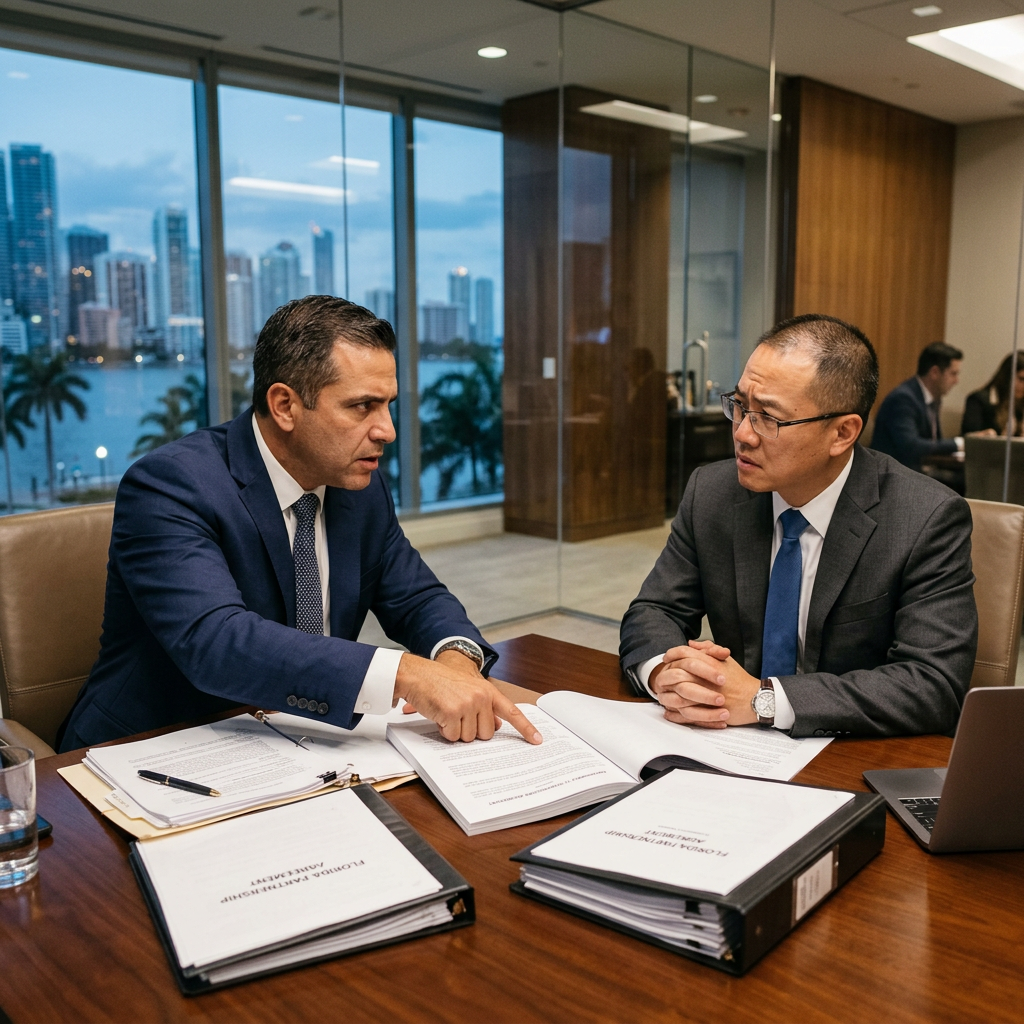
Florida business partner breach of contract — litigation attorney

When a business partner breaches a contract in Florida, it rarely happens all at once — it usually starts with missed obligations, then excuses, then silence, and by the time you realize the extent of it, the damage is already done. Florida business partner breach of contract cases are some of the most contentious disputes in civil litigation because they involve both a legal claim and a personal betrayal. What you do in the first few weeks after discovering the breach shapes everything that follows — including how much you recover and how quickly.

Florida Statute §542.001 governs contract formation provides the legal framework for these disputes.

What Qualifies as a Contract Breach in a Florida Business Partnership

Learn more at Florida Statute §542.335. Florida Statute §606.2014 (LLC operating agreements) Florida Statute §620.8501 (partnership duties)

Material vs. Minor BreachFlorida breach of fiduciary duty — business litigation attorney

Not every missed obligation is a breach that justifies ending the relationship or filing suit. Florida law distinguishes between a material breach — one that goes to the heart of what you contracted for — and a minor or partial breach that still entitles you to damages but doesn’t justify stopping your own performance. Getting this distinction right matters because if you treat a minor breach as material and walk away from your own obligations, you become the breaching party.

The Most Common Breaches in Florida Business Partnerships

  • Failure to contribute agreed capital or meet funding obligations
  • Diverting partnership revenue or clients to a separate competing entity
  • Making unauthorized commitments that bind the partnership legally
  • Refusing to comply with buyout provisions when triggered
  • Violating non-compete or non-solicitation clauses in the partnership agreement
  • Failing to perform agreed management duties, causing the business to suffer
  • Florida Uniform Partnership Act — governs partner obligations and breach remedies

If your partner’s conduct fits any of these patterns, you’re dealing with a breach that warrants immediate legal advice. A Florida business litigation attorney can help you document it properly before confronting your partner directly.

Your First Steps After Discovering a Breach

Document Before You Confront

This is the mistake most business owners make — they call their partner, get into an argument, and give them time to cover tracks or move assets. Before you say anything, pull every document you have access to: bank records, financial statements, client lists, emails, and contracts. Preserve them somewhere your partner can’t access or delete. Once you’ve done that, your attorney can help you decide the right way to approach the situation — including whether to seek an emergency injunction before your partner realizes litigation is coming.

Review the Partnership Agreement First

The written agreement controls what remedies are available to you, how disputes must be handled, and what notice you have to give before suing. Some agreements require a cure period — giving the breaching partner time to fix the problem before you can file. Others mandate mediation first. Skipping these steps can hurt your case even when you’re clearly in the right. The Florida Revised Uniform Partnership Act (Chapter 620) fills any gaps your agreement leaves.

Legal Remedies Available When a Florida Business Partner Breaches

What Florida Courts Can Award

Under Florida Statute §825.103 on fiduciary duties,

Remedy What It Covers
Compensatory damages Financial losses directly caused by the breach — lost profits, diverted revenue, wasted capital
Specific performance Court orders the partner to actually perform — useful when the breach involves withholding a buyout or blocking a sale
Injunctive relief Emergency order blocking ongoing harm — competing against the partnership, accessing accounts, soliciting clients
Accounting Court-ordered financial review to find misappropriated funds or unauthorized distributions
Dissolution If the breach makes continued operation impracticable, courts can order the partnership wound up

Injunctions — When You Need to Stop the Bleeding Now

If your partner is actively competing against the business, draining accounts, or continuing to solicit your clients — waiting for a trial date is not an option. Florida courts can issue a temporary injunction within days when you can show ongoing irreparable harm. Your Florida contract dispute attorney needs to file an emergency motion before the partner knows what’s coming. Once assets are moved or clients are gone, getting them back is much harder.

What Happens When There’s No Written Agreement

Florida’s Default Rules Kick In

If your partnership operates without a written agreement — which happens more often than it should — Florida’s Revised Uniform Partnership Act governs everything. Under the default rules: profits and losses are split equally regardless of capital contribution, every partner has equal management rights, and any partner can trigger dissolution by express will. Without a written agreement, proving what you both actually agreed to becomes a factual dispute — expensive to litigate and unpredictable to win. Get an experienced Florida business attorney involved immediately if you’re in this situation.

Frequently Asked Questions

For more information, see FindLaw – Florida Breach of Contract.

For more information, see Florida Statute §689.261.

Question Answer
How long do I have to sue a business partner for breach of contract in Florida? 5 years for a written contract; 4 years for an oral agreement. The clock starts when the breach occurred — not when you discovered it, in most cases.
Can I sue my partner personally or just the partnership? Both. In a general partnership, partners are personally liable for each other’s breaches in their capacity as partners. In an LLC, personal liability is more limited but still possible in cases of fraud or bad faith.
What if my partner claims I also breached the agreement? Cross-claims are standard in partnership disputes. Document your own performance thoroughly before filing anything.
Do I have to go to mediation first? Check your partnership agreement. Many include mandatory mediation clauses. Florida courts also require it before trial in most civil cases.

A Partner Breach Gets Worse with Every Day You Wait

The longer a Florida business partner breach of contract goes unaddressed, the more damage compounds. Feinstein Law handles partner disputes and breach of contract litigation throughout South Florida. Call (954) 767-9662 or reach us at our contact page.

About Feinstein Law: Feinstein Law is a Fort Lauderdale litigation firm serving clients in business, real estate, and contract disputes throughout Broward, Miami-Dade, and Palm Beach counties.

By : Michael Feinstein | February 19, 2026 | Business Litigation

How Mediation Works in Florida Real Estate Disputes

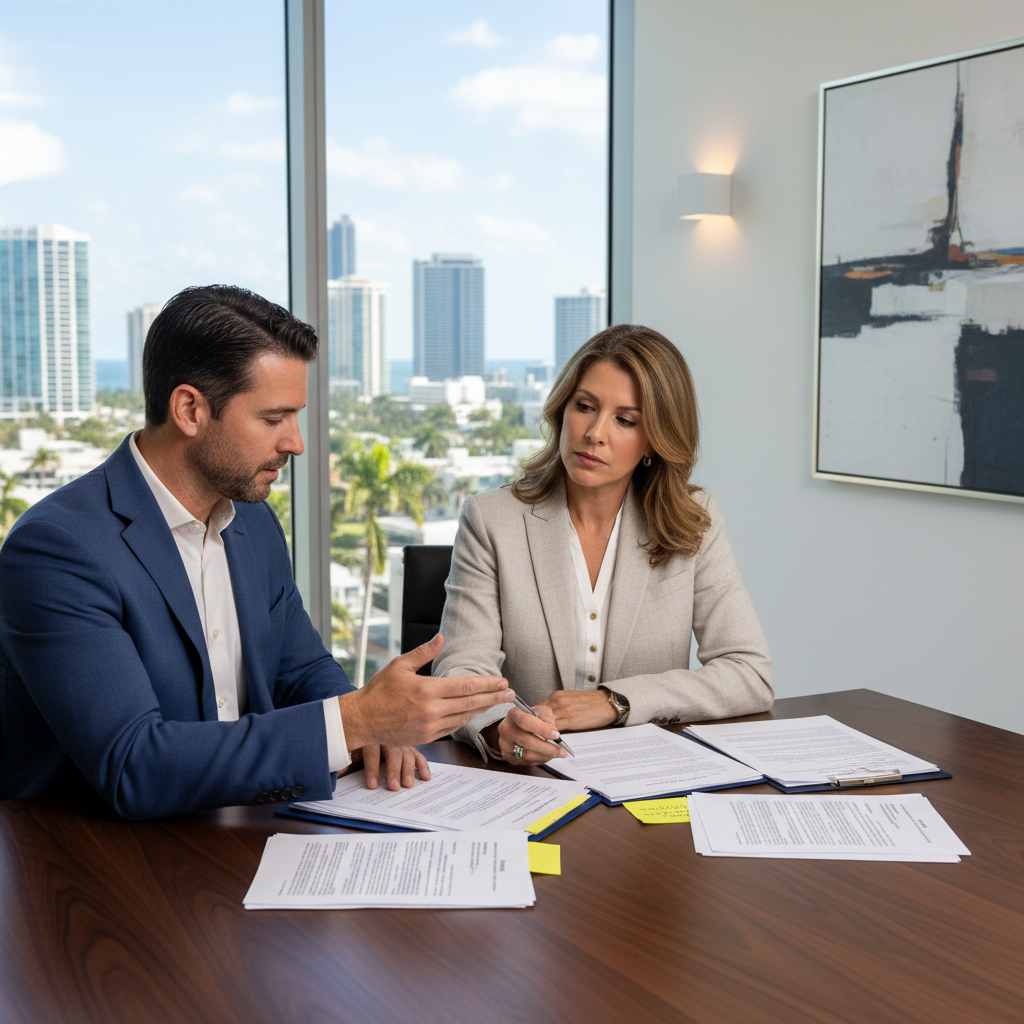
Florida real estate mediation attorney — parties in conference room

If you’re in a Florida real estate dispute and someone just mentioned mediation, you might be wondering whether it’s worth your time or just a delay tactic before the real fight begins. Mediation in Florida real estate disputes is not optional in most cases — it’s required before trial under both standard contract clauses and court rules. But more importantly, it works. The majority of Florida real estate cases that reach mediation settle there, avoiding months of discovery and the unpredictability of a jury. Here’s how the process actually operates and how to use it strategically.

Why Florida Requires Mediation Before Trial

It’s Built Into Most Contracts

The standard FAR/BAR residential contract used throughout Florida contains a mandatory mediation clause. Commercial contracts frequently do too. This means if you signed a Florida real estate contract — as a buyer, seller, landlord, or tenant — you almost certainly agreed to mediate before filing a lawsuit. Courts also independently order mediation in most civil cases under Florida’s civil procedure rules. Skipping it can get your case dismissed or delay it significantly.

What the Court Actually Requires

Once a case is filed in Florida circuit court, the judge will typically enter a case management order setting a mediation deadline — often within 90–120 days of the case being at issue. The parties share the mediator’s fee equally unless agreed otherwise. Failure to participate in good faith can result in sanctions. An experienced Florida real estate litigation attorney treats mediation as a serious strategic opportunity, not a box to check.

How a Florida Real Estate Mediation Actually Works

Choosing the MediatorFlorida business mediation — attorney presenting settlement terms

The parties typically agree on a certified Florida mediator — often a retired judge or experienced attorney who specializes in real estate contract disputes. If the parties can’t agree, the court appoints one. In South Florida, mediators with specific real estate expertise are available and worth the slightly higher rate. Their credibility with both sides moves cases toward settlement faster.

The Day of Mediation — What to Expect

  • Opening joint session — both sides present their positions briefly to the mediator
  • Separate caucuses — mediator shuttles between rooms, conveying offers and testing positions privately
  • Reality testing — the mediator pushes each side to honestly evaluate their risks at trial
  • Settlement negotiation — once both sides move toward a range, terms are drafted and signed same day
  • Impasse — if no agreement, the mediator declares impasse and the case proceeds to litigation

Sessions typically run 3–6 hours. Having your Florida litigation attorney present — not just on the phone — makes a measurable difference in outcomes.

Common Florida Real Estate Disputes That Resolve at Mediation

Where Mediation Has the Highest Success Rate

Dispute Type Why Mediation Works Well
Earnest money deposit disputes Both sides know trial costs could exceed the deposit amount — settlement math is obvious
Seller non-disclosure claims Sellers want to avoid public record of concealed defects; buyers want money, not a trial
Commercial lease disputes Both landlord and tenant need to maintain functional business relationships or exit cleanly
Construction defect claims Expert witnesses are expensive — settlement almost always beats paying for trial experts
Partition actions Co-owners often reach buyout agreements at mediation rather than forcing a court-ordered sale

When Mediation Doesn’t Resolve the Case

Mediation fails when one side has unrealistic expectations, is using the process to delay, or when the legal issues are genuinely novel and need a court ruling. An impasse isn’t a failure — it clarifies the issues and often produces partial agreements that narrow what goes to trial. The American Bar Association’s mediation resources outline how courts evaluate good-faith participation.

What Makes Mediation Succeed in Florida Real Estate Cases

Preparation Is Everything

Parties who walk into mediation without a mediation statement, without a clear damages calculation, and without a realistic settlement range waste everyone’s time — including their own. Your attorney should prepare a concise mediation brief that lays out your strongest points, the weaknesses in your case, and a realistic bottom line. Mediators use these to move the other side.

Authority to Settle

The person at the table needs actual authority to agree to a settlement number on the spot. If every offer has to be run by an absent decision-maker, the session stalls. Florida courts can sanction parties who attend mediation without proper settlement authority.

Costs and ConfidentialityFlorida mediation vs litigation — attorneys presenting resolution options

What Florida Mediation Costs

  • Certified Florida mediators typically charge $200–$500/hour depending on specialty and experience
  • Sessions run 3–6 hours on average; complex cases may require multiple sessions
  • Total cost split equally: typically $600–$1,500 per party for a standard real estate dispute
  • Compare that to trial costs, which routinely run $50,000–$200,000+ in contested Florida real estate litigation

Everything Said in Mediation Stays There

Florida’s mediation confidentiality statute protects all communications during mediation from being used in court. Offers made and positions taken at mediation cannot be introduced as evidence at trial. This allows both sides to speak candidly about their real concerns — which is exactly what makes settlement possible.

Frequently Asked Questions

Question Answer
Can I be forced to settle at mediation in Florida? No. Mediation is non-binding — you can walk away. But courts require participation in good faith, and refusing to make any reasonable offer can result in sanctions.
What if the other side won’t participate in mediation? File a motion to compel mediation. Courts will order it, and repeated failure to participate can result in adverse rulings.
Does settling at mediation mean I give up my rights? Only the rights you specifically settle. The written agreement controls exactly what’s released. Your attorney reviews it before you sign.

Mediation Is Where Most Florida Real Estate Disputes End — Use It Strategically

Feinstein Law represents buyers, sellers, landlords, and tenants in Florida real estate mediation and litigation throughout South Florida. Call (954) 767-9662 or contact us at our contact page.

About Feinstein Law: Feinstein Law is a Fort Lauderdale litigation firm handling real estate, business, and contract disputes throughout Broward, Miami-Dade, and Palm Beach counties.

By : Michael Feinstein | February 12, 2026 | Contract Disputes

Resolve Construction Contract Disputes In South Florida

Fort Lauderdale Construction Litigation Lawyer

Construction Project Going Sideways?

Don’t Wait for Court—Resolve Your Contractor Dispute Now

Construction Litigation Attorney | South Florida

The Harsh Reality: Every month you wait to address contractor problems costs you money, delays your project, and increases the likelihood of ending up in expensive litigation. With over 40 years of construction and real estate law experience, Michael Feinstein has seen it all—and knows exactly how to stop problems before they spiral out of control.

You’ve invested significant capital into your construction project—whether it’s a high-end residential renovation, a commercial development, or a multi-family property. You’ve done your due diligence, hired what you thought were reputable contractors, and expected professional results. But now something’s gone wrong.

Maybe the work is substandard. Perhaps costs are spiraling beyond your approved budget. The timeline has stretched from months into what feels like years. Or worse—your contractor has disappeared, leaving you with an unfinished project and mounting bills.

Here’s what you need to understand, waiting to address these issues only makes them worse. The difference between a manageable dispute resolution and a catastrophic litigation nightmare often comes down to how quickly you engage experienced legal counsel.

South Florida construction contract dispute with builder and attorney on job site

Common Construction Disputes That Threaten Your Investment

  • Contract Breaches: When contractors fail to perform work according to agreed specifications, timelines, or quality standards outlined in your construction contract.
  • Cost Overruns: Unauthorized budget increases, inflated change orders, and project costs that exceed contracted amounts without proper documentation or approval.
  • Construction Defects: Substandard workmanship, code violations, structural problems, and material defects that compromise safety, value, or functionality.
  • Timeline Delays: Missed deadlines, extended completion dates, and scheduling conflicts that cost you money in extended carrying costs and lost opportunities.
  • Mechanic’s Liens: Legal claims filed against your property by contractors, subcontractors, or suppliers for unpaid work—threatening your ownership rights.
  • Design Disputes: Conflicts between architects, engineers, and contractors over design specifications, buildability issues, and responsibility for design errors.
  • Scope Creep: Unauthorized work, undocumented changes, and disputes over what was included in the original contract scope.
  • Payment Disputes: Disagreements over payment schedules, withholding for defective work, and conflicts over final payment and project closeout.

Warning Signs Your Construction Project Needs Legal Intervention

  • Consistent missed deadlines with vague excuses and no corrective action plan
  • Quality issues that the contractor refuses to acknowledge or repair
  • Unexpected cost increases without proper documentation or change order procedures
  • Communication breakdown where your contractor stops returning calls or emails
  • Work stoppage with materials or workers disappearing from your job site
  • Lien threats from subcontractors or suppliers claiming non-payment
  • Code violations discovered during inspections that the contractor should have prevented
  • Safety concerns indicating negligent or reckless construction practices
  • Payment disputes where the contractor demands money for incomplete or defective work
  • Contractor threatening litigation or making legal demands without proper basis

The True Cost of Waiting: Litigation vs. Early Resolution

Average Costs: Early Intervention vs. Court Litigation

  • Early Resolution: $15K-$50K (typically 2-6 months)
  • Court Litigation: $150K-$500K+ (typically 18-36 months)
Factor Early Legal Intervention Going to Court
Timeline 2-6 months typical resolution 18-36 months to trial verdict
Cost Range $15,000-$50,000 $150,000-$500,000+
Control Over Outcome High – You negotiate terms Low – Judge/jury decides
Business Disruption Minimal – Focused negotiation Extensive – Depositions, discovery, trial prep
Confidentiality Private settlement Public court record
Relationship Preservation Possible to maintain working relationship Adversarial – Burns bridges
Project Completion Can resume work quickly Often halted until resolution
Success Predictability Negotiated certainty Uncertain jury verdicts

The Feinstein Approach: Strategic Resolution Before Court

  1. Immediate Case Assessment: We conduct a comprehensive review of your construction contract, project documentation, correspondence, and current situation. This includes analyzing your legal position, potential exposure, and leverage points for negotiation.
  2. Document Everything: We work with you to compile and organize all relevant evidence: contracts, change orders, payment records, photographs, inspection reports, expert opinions, and communications. Proper documentation is your strongest weapon.
  3. Strategic Demand Letter: Our firm sends a detailed legal demand letter outlining the violations, required remedies, and consequences of non-compliance. This formal notice often motivates contractors to take your concerns seriously and engage in meaningful dialogue.
  4. Negotiated Settlement: We leverage our 40+ years of construction law experience to negotiate favorable terms: completion of work, cost reductions, schedule acceleration, or monetary settlements. Most disputes resolve at this stage.
  5. Alternative Dispute Resolution: If direct negotiation fails, we pursue mediation or arbitration—structured processes that resolve disputes faster and more cost-effectively than court litigation while still protecting your interests.
  6. Litigation When Necessary: If all pre-litigation efforts fail, we’re fully prepared to take your case to court. Our trial experience ensures aggressive representation and the highest probability of success when litigation becomes unavoidable.

Why High Net Worth Property Owners Choose Feinstein Law

  • 40+ Years Experience
  • 100+ Trial Cases
  • $100M+ Transactions Managed
  • AV Preeminent Rated

Michael L. Feinstein, EsquireFort Lauderdale Real Estate Litigation Attorney

  • AV Preeminent Peer Review Rated by Martindale-Hubbell
  • Florida Licensed Real Estate Broker with deep market knowledge
  • Former Licensed Mortgage Broker (25+ years)
  • Represents ultra-high net worth clients in complex construction disputes
  • Successfully resolved hundreds of construction and contractor disputes
  • Extensive trial experience in state and federal courts
  • Recognized expert in South Florida construction and real estate law

The Feinstein Advantage: Triple Expertise. Unlike general practice attorneys, Michael Feinstein brings a unique triple qualification to your construction dispute: Attorney + Real Estate Broker + Former Mortgage Broker. This comprehensive understanding of construction law, real estate transactions, and financing means he sees angles other attorneys miss and negotiates from a position of superior knowledge.

Common Construction Disputes We Handle in South Florida

Whether your property is in Fort Lauderdale, Miami Beach, Palm Beach, Boca Raton, or anywhere across South Florida’s high-end real estate markets, we handle all construction-related disputes:

  • Residential Construction: Custom homes, luxury renovations, oceanfront properties, historic restorations, additions and remodels
  • Commercial Projects: Office buildings, retail centers, restaurants, hotels and resorts, mixed-use developments
  • Multi-Family Properties: Condominiums, apartment complexes, HOA construction disputes, building envelope issues
  • Industrial & Warehouse: Distribution centers, manufacturing facilities, logistics properties, industrial conversions

Real-World Impact: When Early Intervention Saves Your Project

Consider a recent client: a high net worth investor who purchased a historic property for conversion into luxury residences. The contractor fell behind schedule, quality issues emerged, and costs escalated dramatically. When subcontractors threatened liens, our client engaged our firm.

Within 60 days, we:

  • Documented all contract violations and defective work
  • Negotiated removal of the problematic general contractor
  • Facilitated engagement of qualified replacement contractors
  • Prevented all mechanic’s liens from being filed
  • Secured a settlement that covered remediation costs
  • Got the project back on track without litigation

Estimated litigation costs without intervention: $300,000+ and 18-24 months of delays.

Contact Feinstein Law

Call (954) 767-9662
Email for Consultation
Contact Our Firm

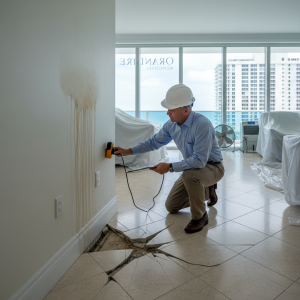
Frequently Asked QuestionsFlorida construction defect claim — engineer inspecting damage

When should I contact a construction attorney?

Immediately when you notice contract violations, quality issues, cost overruns, or communication breakdown. The earlier you engage legal counsel, the more options you have and the lower your costs will be. Don’t wait until your contractor has disappeared or liens have been filed.

How much does it cost to resolve a construction dispute?

Early intervention typically costs $15,000-$50,000 and resolves within 2-6 months. Full litigation can cost $150,000-$500,000+ and take 18-36 months. The investment in early legal representation almost always saves money compared to waiting.

Can you help if my contractor has already filed a lawsuit?

Absolutely. While early intervention is ideal, we aggressively defend construction lawsuits and have extensive trial experience. We can assess your case, develop defense strategy, and pursue favorable resolution or trial victory.

What if I’ve already paid the contractor in full?

You still have legal remedies. Depending on the defects and contract violations, you may be entitled to damages, cost of repairs, or other compensation. We can assess your rights and pursue recovery.

Do you handle disputes with architects and engineers?

Yes. Construction projects involve multiple parties, and we have extensive experience with architect-owner disputes, engineer liability, design defect claims, and professional negligence matters.

What areas of South Florida do you serve?

We represent clients throughout South Florida, including Fort Lauderdale, Miami, Miami Beach, Boca Raton, Palm Beach, Coral Gables, Aventura, Sunny Isles, Key Biscayne, and surrounding areas. Our Fort Lauderdale office is centrally located to serve the entire region.

Feinstein Real Estate Litigation & Business Law
501 E Las Olas Blvd, Suite 300
Fort Lauderdale, FL 33301
Phone: (954) 767-9662
Alternative: (561) 380-8129

The information provided in this blog is for general informational purposes only and does not constitute legal advice. Every construction dispute is unique and requires individual analysis. Contact Feinstein Law for specific guidance on your situation.

By : Michael Feinstein | January 22, 2026 | Construction Litigation

Real Estate Attorney Fort Lauderdale: Why Experience Matters for Your Property

Real estate attorney's desk with contract, clipboard, and glasses representing property closing paperwork in Fort Lauderdale

Real Estate Attorney Fort Lauderdale: Why Experience Matters for Your Property

When you’re buying or selling property in Fort Lauderdale, working with a real estate attorney Fort Lauderdale can make the difference between a smooth transaction and an expensive mistake. An experienced Fort Lauderdale real estate lawyer understands the local market, the unique paperwork, and the small details that can cause big problems. They handle everything from closings and contract reviews to resolving disputes, so you can focus on your new home or investment. From reviewing contracts to ensuring clear title, hiring a real estate attorney Fort Lauderdale helps protect your investment and your rights from day one.

What Does a Fort Lauderdale Real Estate Attorney Do?

Here are some of the key services a local attorney provides during your transaction:

Service Why It Matters
Contract Review & Drafting Ensures purchase agreements, leases and other documents reflect your interests and comply with Florida law.
Title Examination Identifies liens or title defects before closing to prevent future disputes.
Closing Coordination Manages the signing, funding and recording process so your transaction is executed correctly.
Dispute Resolution Represents you in negotiations, mediation or litigation if conflicts arise during the transaction.
Investment & Development Advice Offers guidance on structuring deals, zoning, and land-use issues for commercial or residential projects.

Why Experience and Local Knowledge Matter

In real estate, small details can turn into costly problems. An attorney who has handled hundreds of deals in Fort Lauderdale understands local ordinances, common title issues and how to avoid them. The Broward County Clerk of Courts notes that its County Civil/Small Claims department handles disputes under $50,000 and that representation isn’t required, but for more complex matters you should seek legal advice. Having an attorney by your side ensures that you make informed decisions and that someone is watching out for your rights.

Experience also means knowing how to navigate Florida’s unique laws. The Department of Business and Professional Regulation (DBPR) investigates and punishes license violations, and a seasoned lawyer helps you avoid working with unlicensed or unethical parties. Because Fort Lauderdale real estate values can be high, the cost of a mistake often outweighs the investment in competent legal counsel.

When Should You Hire a Real Estate Attorney?

A good rule of thumb is to involve an attorney anytime significant money or legal risk is involved. Common scenarios include:

  • Property Closings: A lawyer coordinates the closing, reviews the settlement statement and ensures that funds are properly disbursed.
  • Contract Drafting and Review: Whether you’re signing a purchase agreement, lease or partnership agreement, an attorney ensures the language protects your interests.
  • Title or Boundary Disputes: If a neighbor claims part of your yard or a title search uncovers a lien, an attorney can help resolve the issue.
  • Landlord–Tenant Issues: Evictions, lease enforcement and deposit disputes often require legal expertise; the Broward Clerk’s office notes that you may choose to seek legal advice for complex matters.
  • Investment and Development Projects: Attorneys advise on zoning, permitting, financing and structuring deals to minimize risk.

How to Choose the Right Fort Lauderdale Real Estate Attorney

Not all attorneys offer the same level of service. When selecting counsel, consider the following:

  • Experience & Track Record: Look for someone who has handled transactions similar to yours and who knows Fort Lauderdale’s neighborhoods and regulations.
  • Licensing & Discipline: Verify the attorney’s license through the DBPR. The department investigates license law violations and can revoke or suspend licenses.
  • Communication: Choose an attorney who explains things clearly, answers your questions and keeps you informed throughout the process.
  • Fee Structure: Ask about hourly rates, flat fees or contingent arrangements so there are no surprises.
  • Local Reputation: A lawyer with strong ties to Broward County courts and real estate professionals can often resolve issues more efficiently.

The City of Jacksonville suggests checking your closing documents for a survey and contacting your closing attorney if one is missing—another example of why having knowledgeable counsel is useful.

Real Estate Attorney vs. Title Company

Title companies handle the paperwork and insurance for closings, but they cannot give legal advice. They prepare documents and ensure that funds change hands. A real estate attorney, however, represents your interests, can modify contract terms, and advocates for you if a dispute arises. If something goes wrong, an attorney can negotiate, file claims or defend you in court. Many clients choose to hire both—a title company to manage the mechanics of closing and a lawyer to ensure the transaction protects them.

Frequently Asked Questions

Q1: Do I need a real estate attorney to close on a property in Florida?
You are not legally required to hire a lawyer, but closings involve significant money and legal obligations. An attorney reviews contracts, explains your rights and handles issues like title defects. This extra layer of protection can prevent costly mistakes.

Q2: What does a real estate attorney do during a closing?
They coordinate the signing of documents, ensure the deed and mortgage are prepared correctly, review the settlement statement, and confirm that funds are transferred to the right parties. They also resolve last-minute issues so the deal closes on schedule.

Q3: Can a real estate attorney help with landlord–tenant disputes?
Yes. Attorneys handle evictions, lease enforcement, deposit disputes and other issues. The Broward County Clerk’s office notes that while you can represent yourself in small claims, you may want a lawyer for more complex cases.

Q4: How do I verify a lawyer’s license?
You can look up a lawyer’s license and disciplinary history through the Florida DBPR website, which investigates complaints and enforces license laws.

Q5: What should I bring to my first consultation?
Bring any purchase agreements, leases, surveys, closing statements and correspondence related to your transaction. Having these documents allows your attorney to assess the situation and provide targeted advice.

If you’re preparing for a closing, facing a dispute or planning an investment, Feinstein Real Estate Litigation and Business Law is here to help. Our Fort Lauderdale real estate contract attorneys have deep knowledge of local law and decades of experience. Learn more about our founding attorney Michael L. Feinstein or why clients trust us, and contact us today to protect your property and your rights.

By : Michael Feinstein | August 6, 2025 | Business Litigation

Las Olas Breach of Contract Attorney

Las Olas Breach of Contract Attorney near me

Las Olas Breach of Contract Attorney Services

Addressing Breach of Contract Issues in Las Olas: Legal Insights and Solutions

Contracts are the foundation of business operations, establishing clear expectations and obligations between parties. When a breaches of contract occurs, it can disrupt your business and lead to significant financial and legal consequences. Feinstein Real Estate Litigation & Business Law, located in the heart of Las Olas, Fort Lauderdale, and our breach of contract attorneys specialize in handling these cases, providing the expertise and dedication needed to resolve these disputes effectively.

Understanding Breach of Contract

A breach of contract occurs when one party fails to fulfill their obligations under the terms of the agreement. This can take several forms, including:

  • Non-performance: The party fails to perform the agreed-upon action.
  • Partial performance: The party performs only part of their obligations.
  • Anticipatory breach: The party indicates they will not perform their obligations in the future.

Key Strategies for Resolving Breach of Contract Disputes

  1. Thorough Contract Review
    • Conducting a detailed review of the contract to understand its terms and conditions.
    • Identifying any ambiguities or potential defenses that may impact the case.
  2. Documentation and Evidence Gathering
    • Collecting all relevant documentation, such as emails, correspondence, and records of performance.
    • Preserving evidence that supports your claim of breach and the resulting damages.
  3. Negotiation and Mediation
    • Exploring opportunities for negotiation and mediation to resolve the dispute without litigation.
    • Utilizing skilled negotiators to achieve a settlement that protects your interests.
  4. Litigation and Legal Representation
    • Aggressively representing your interests in court to enforce the contract terms and seek damages.
    • Handling all stages of litigation, from filing the complaint to trial and appeal if necessary.

The Role of a Breach of Contract Attorney

A breach of contract attorney plays a vital role in guiding businesses through these disputes. At Feinstein Real Estate Litigation & Business Law, our attorneys offer:

  • Expert Legal Advice: Providing clear and actionable legal advice tailored to the specifics of your case.
  • Strategic Representation: Representing clients in negotiations, mediations, and court proceedings with a focus on achieving the best possible outcome.
  • Comprehensive Support: Managing all aspects of the case, from initial assessment to final resolution.

Las Olas Breach of Contract Attorney Frequently Asked Questions

  • What constitutes a breach of contract?
    • A breach of contract occurs when one party fails to fulfill their obligations under the terms of the contract, whether through non-performance, partial performance, or anticipatory breach.
  • How can I prove a breach of contract?
    • To prove a breach of contract, you must show that a valid contract exists, you performed your obligations, the other party failed to perform, and you suffered damages as a result.
  • What remedies are available for a breach of contract?
    • Remedies may include compensatory damages, specific performance, rescission, and restitution.
  • How long do I have to file a breach of contract lawsuit?
    • In Florida, the statute of limitations for written contracts is five years, and for oral contracts, it is four years from the date of the breach.
  • Can a breach of contract be resolved out of court?
    • Yes, many breaches of contract can be resolved through negotiation, mediation, or arbitration, which can save time and legal costs.

Las Olas Breach of Contract Attorney Local Resources 

Having access to local resources can be invaluable when dealing with breach of contract disputes. Here are some key resources in the Las Olas area:

Get Help From A Las Olas Breach of Contract Attorney

Addressing breach of contract issues requires a strategic approach and the expertise of seasoned legal professionals. Feinstein Real Estate Litigation & Business Law is dedicated to providing exceptional legal representation and tailored solutions for businesses facing breach of contract disputes in Las Olas. Contact us today to schedule a consultation and learn how we can assist with your legal needs. Call 954-767-9662

By : admin | August 2, 2024 | Contract Disputes

Your Insider Guide To South Florida Real Estate Contract Disputes

Florida-Real-Estate-Contract-Disputes-Lawyer

Florida Real Estate Contract Disputes

Real estate transactions in Florida are subject to their own set of challenges, with real estate contract disputes being among the most prevalent issues faced by buyers, sellers, and real estate professionals alike. These disputes often stem from misunderstandings or disagreements regarding the terms of a real estate contract. Let’s explore the nature of real estate contract disputes in Florida, providing insights on how to prevent and resolve such disagreements effectively and learning from a trusted Real Estate Ligitaion attorney.

[ez-toc]

How Common Are Florida Real Estate Contract Disputes in Florida?

Real estate contract disputes are relatively common in Florida’s real estate market. The state’s attractive real estate landscape, from the bustling urban areas to serene waterfront properties, creates a competitive environment ripe for misunderstandings and contractual disagreements.

The complexity of transactions, combined with Florida’s specific legal stipulations regarding real estate, can often lead to disputes that range from minor misunderstandings to significant legal confrontations. These issues underscore the importance of detailed contracts, clear communication, and the guidance of experienced legal professionals.

What Triggers Real Estate Contract Disputes in Florida?

Florida-Real-Estate-Contract Disputes-Attorney

Several factors contribute to the prevalence of Florida Real Estate contract disputes:

Ambiguities in Contract Language

Unclear terms or vague language in real estate contracts can lead to differing interpretations by the parties involved, resulting in disputes over the contract’s intent and provisions.

Failure to Fulfill Contractual Obligations

Disagreements often arise when one party perceives that the other has failed to meet their obligations under the contract, whether it be related to property condition, closing timelines, or financial terms.

Discrepancies Over Property Disclosures

Sellers are required to disclose known defects or issues with the property. Disputes can occur when buyers believe that not all issues were disclosed or were inadequately described.

Strategies for Preventing Real Estate Contract Disputes

Implementing certain strategies can help prevent many of the disputes that arise during real estate transactions:

Draft Clear and Detailed Contracts

Ensuring that all terms, conditions, and obligations are clearly defined and detailed in the contract can prevent many disputes from arising.

Open and Honest Communication

Maintaining transparent communication between all parties throughout the transaction process can help clarify expectations and prevent misunderstandings.

Utilize Professional Real Estate Attorneys

Engaging a Florida real estate attorney to review or draft contracts can provide an additional layer of security and understanding, ensuring that all legal requirements are met and reducing the likelihood of disputes.

Resolving Real Estate Contract Disputes

When disputes arise, there are several paths to resolution:

Negotiation and Reconciliation

  • Often, disputes can be resolved through direct negotiation between the parties, potentially with the assistance of their respective attorneys.

Mediation

  • Mediation involves a neutral third party who helps facilitate a mutually acceptable resolution to the dispute without the need for litigation.

Arbitration or Litigation

  • In cases where negotiation and mediation fail, arbitration or litigation may be necessary. These processes involve a more formal resolution method, potentially leading to a binding decision.

Seeking Expert Legal Assistance in Florida

Given the complexities of Florida’s real estate market and the potential for contract disputes, having the support of an experienced real estate attorney is invaluable. An attorney can offer guidance on contract drafting, dispute prevention, and resolution strategies tailored to Florida’s specific legal landscape.

Feinstein Law: Your Partner in Resolving Florida Real Estate Contract Disputes

Navigating the intricacies of real estate contract disputes in Florida demands a proactive approach, detailed contracts, and the guidance of experienced legal professionals. By understanding the common causes and effective resolution strategies, parties can safeguard their interests in Florida’s competitive real estate market.

Call Michael L. Feinstein For Immediate Assistance

If you’re navigating a real estate contract dispute in Florida or wish to proactively address potential issues, Feinstein Law is here to offer expert advice and support. Reach out to our team to ensure your real estate transactions are secure and dispute-free. Let us help you resolve Florida’s real estate contracts with confidence.

By : admin | February 15, 2024 | Contract Disputes
Call Now