


 954-767-9662

Non-Compete Attorney in Florida

A non-compete attorney enforces or challenges agreements that limit where a former employee, contractor, or business seller can work or compete. Michael L. Feinstein is a Florida attorney and licensed Florida real estate broker with more than 30 years of experience. He represents businesses protecting clients and confidential information, and individuals who want to know what a signed agreement really allows. Florida enforces these agreements more readily than many states. Since 2025, it enforces some of them even more strictly. As your non-compete attorney, Michael explains where you stand.
What Is a Non-Compete Agreement in Florida?
A non-compete is one kind of restrictive covenant. Florida’s main statute is section 542.335. To be enforced, the covenant must be in a writing signed by the person it restricts. The business must prove a legitimate business interest, such as trade secrets, confidential information, customer relationships, goodwill, or specialized training. The restraint must also be reasonable in time, area, and line of business. A court must narrow an overbroad restraint rather than throw it out. Courts may not consider the individual hardship of the person restricted.
The same statute covers related promises. These include non-solicitation of clients or employees, confidentiality terms, and restrictions in the sale of a business. A business that relies on trade secrets may also have claims under Florida’s Uniform Trade Secrets Act. Many disputes involve several of these promises at once, so the whole agreement matters, not just the non-compete clause.
Florida Non-Compete Rules at a Glance
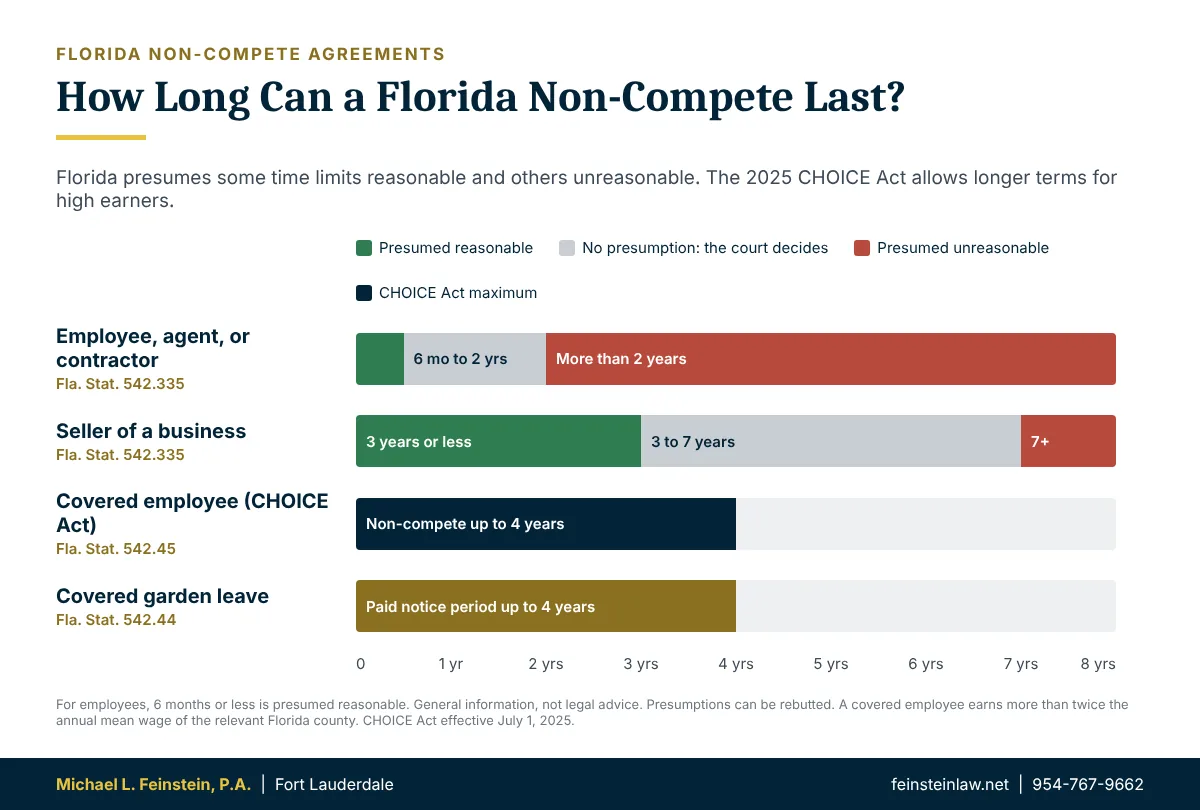
How long a restraint can last depends on who signed it.
| Who signed | Time limits | Florida law |
|---|---|---|
| Employee, agent, or contractor | 6 months or less presumed reasonable; more than 2 years presumed unreasonable | section 542.335(1)(d) |
| Seller of a business | 3 years or less presumed reasonable; more than 7 years presumed unreasonable | section 542.335(1)(d) |
| “Covered employee” under the CHOICE Act | Non-compete of up to 4 years | section 542.45 |
| “Covered” garden leave | Paid notice period of up to 4 years | section 542.44 |
Defenses in a Non-Compete Dispute
When a business sues to enforce a non-compete, common defenses include:
- There is no legitimate business interest to protect.
- The agreement was never signed by the person it restricts.
- The time, area, or line of business is broader than needed.
- The new job does not compete or use confidential information.
- For a CHOICE Act agreement, the employer skipped a required step or did not pay.
For more, see our article on whether Florida non-compete agreements are enforceable.
Non-Compete Injunctions and the CHOICE Act
Most non-compete cases are decided early, at the injunction stage. Under section 542.335, breaking an enforceable covenant creates a presumption of irreparable injury. The CHOICE Act, effective July 1, 2025, goes further for covered employees. A covered employee earns more than twice the annual mean wage of the relevant Florida county. The employee must receive the agreement at least 7 days before the offer expires. The employee must also be told in writing of the right to see a lawyer. If those terms are met, a court must issue a preliminary injunction. The employee can lift it only with clear and convincing evidence. The FTC’s 2024 nationwide ban never took effect. See our guide to preliminary injunctions in business disputes.
Non-Compete Attorney Serving Broward County
Michael handles non-compete cases from his Las Olas Boulevard office in Fort Lauderdale. Cases are usually filed in circuit court. That includes the Seventeenth Judicial Circuit in Broward, the Eleventh in Miami-Dade, and the Fifteenth in Palm Beach. Some agreements choose a court or require arbitration. Non-compete claims often come with trade secret claims and tortious interference claims against a new employer. See our employment contract disputes and business litigation pages.
Non-Compete FAQs
Are non-competes enforceable in Florida?
Yes. Florida enforces non-competes that meet section 542.335: a signed writing, a legitimate business interest, and reasonable limits. Covered agreements under the CHOICE Act are enforced even more strictly.
Can my former employer stop me from working for a competitor?
Sometimes. If your agreement is enforceable and the new job competes in the restricted area and time, a court can enter an injunction. Have the agreement reviewed before you accept the new role.
Who pays the attorney’s fees in a non-compete case?
Often the loser. Under section 542.335, a court may award fees and costs to the prevailing party unless the contract says otherwise. That risk shapes settlement on both sides.
Talk to Michael About Your Non-Compete
Non-compete cases move fast, and a court can rule on an injunction within weeks. Businesses should act quickly to protect clients and information. Individuals should get advice before they resign or start a new role. Bring the agreement, your offer letter, and any notice you received. Call 954-767-9662 or schedule a consultation. Our office on Las Olas Boulevard in Fort Lauderdale is open 9 a.m. to 5 p.m.