Phone

Shareholder Disputes in Florida: When Partners Cannot Agree

What Happens When a Real Estate Contract Falls Through in Florida

How Florida Mediation Saves You Time and Money in Business Disputes

What Does a Broker Commission Dispute Lawyer Do?

Understanding Commercial Real Estate Disputes in Broward County

Call Now Email12
Florida's Business Law Firm
Fort Lauderdale Phone954-767-9662

Shareholder Disputes in Florida: When Partners Cannot Agree

Florida shareholder dispute attorney — business partners in disagreement

If you’re a shareholder in a Florida company and you and your co-owners can no longer agree on anything — management decisions, distributions, exit strategy, compensation — you’re in what courts call a shareholder dispute in Florida, and it can paralyze a business faster than almost any external threat. Florida shareholder disputes between closely held company owners are some of the most contentious and expensive pieces of business litigation, because the financial stakes are intertwined with personal relationships that have usually broken down completely by the time an attorney gets involved. Here’s what you’re dealing with and what the law actually allows.

What Triggers a Florida Shareholder Dispute

It Usually Builds Over Time

Most Florida shareholder disputes don’t start with one dramatic event — they build through accumulated resentment about unequal contributions, compensation disparities, disagreements about the company’s direction, or one shareholder suspecting another of self-dealing. By the time a formal dispute surfaces, both sides have a list of grievances. The legal process then focuses on which of those grievances are actually actionable under Florida law and the governing documents.

Common Catalysts

  • Majority shareholders cutting off distributions while paying themselves inflated salaries
  • A controlling owner entering self-dealing transactions at the company’s expense
  • Deadlock in a 50/50 company where neither partner can force a decision
  • One shareholder wanting to sell the business while the other refuses
  • Minority shareholders being frozen out of management information and financial records
  • Disagreement over valuation in a buyout triggered by death, disability, or voluntary exit

If you’re seeing any of these patterns, speak with a Florida business litigation attorney before the situation deteriorates further.

Florida Law Governing Shareholder Rights

Florida business partners discussing dissolution with attorneys at conference table

The Governing Statutes

Florida’s Business Corporation Act (Chapter 607) governs corporations. The Florida Revised LLC Act (Chapter 605) governs LLCs. Both statutes give shareholders and members specific rights — to inspect company records, to bring derivative suits on behalf of the company, and in certain circumstances, to petition for judicial dissolution. Your shareholder agreement or operating agreement may expand or restrict those statutory defaults — which is why reviewing that document is the first step in any dispute.

The Right to Inspect Records

Florida law gives shareholders the right to inspect and copy company records upon proper written demand. This includes financial statements, meeting minutes, and the list of shareholders. If a controlling owner is blocking access to financial information, this is often the first formal step — sending a statutory inspection demand — before filing suit. It forces the other side’s hand and creates a paper record of obstruction if they refuse.

Remedies Available in Florida Shareholder Disputes

Remedy When It Applies
Damages Financial losses caused by breach of fiduciary duty, self-dealing, or unauthorized distributions
Forced buyout Court orders the majority to buy out the minority at fair value — used when minority is oppressed
Injunction Stops ongoing harm — blocking access to accounts, continued self-dealing, or breach of shareholder agreement
Accounting Court-ordered financial review to identify misappropriated funds or undisclosed transactions
Judicial dissolution Florida courts can dissolve a company when continued operation is not reasonably practicable due to shareholder deadlock or oppression

Minority Shareholder Oppression in Florida

Florida courts recognize minority shareholder oppression as a basis for relief. Oppressive conduct includes freezing out minority shareholders from management, withholding distributions while paying insiders excessive compensation, or conduct that defeats the minority’s reasonable expectations when they invested. If you’re a minority owner being squeezed out, a Florida business dispute attorney can pursue a forced buyout at fair value as an alternative to full litigation. The ABA’s framework on minority oppression in closely held companies outlines the standards courts apply.

Frequently Asked Questions

Question Answer
Can a minority shareholder force a sale of the company in Florida? Not directly — but they can petition for judicial dissolution or a buyout in cases of oppression or deadlock, which often leads to a negotiated sale.
What if our shareholder agreement has no buyout clause? Florida’s default statutory rules apply. Courts will determine fair value using accepted valuation methods — which makes the process more expensive and unpredictable.
Can I get attorney fees in a Florida shareholder dispute? Yes, in certain circumstances — especially derivative suits on behalf of the company where the shareholder prevails and the company benefited.

Florida Shareholder Disputes Can Be Resolved — But Speed Matters

The longer a Florida shareholder dispute drags on, the more the business suffers. Feinstein Law handles shareholder disputes and closely held company litigation throughout South Florida. Call (954) 767-9662 or contact us at our contact page.

About Feinstein Law: Feinstein Law is a Fort Lauderdale firm focused on business litigation, contract disputes, and real estate law throughout Broward, Miami-Dade, and Palm Beach counties.

By : Michael Feinstein | March 31, 2026 | Business Litigation

What Happens When a Real Estate Contract Falls Through in Florida

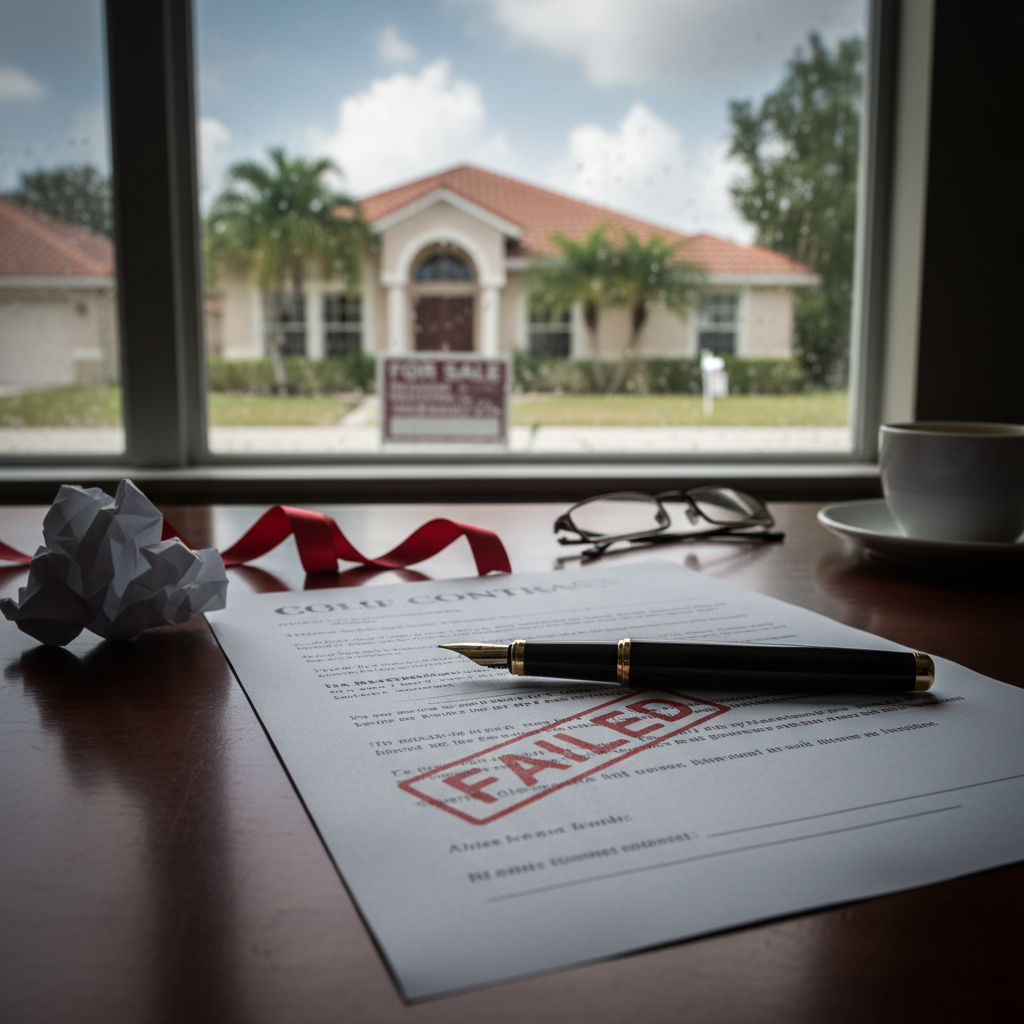
Florida real estate contract falls through — deposit and legal remedies

When a real estate contract falls through in Florida, the fallout depends almost entirely on why it happened and who bears the legal responsibility. You might be a buyer who lost your financing, a seller whose property failed inspection, or one party who simply changed their mind — and the answer to “what happens now?” is completely different in each scenario. Florida real estate contract failures trigger specific legal rights and obligations that begin the moment the deal collapses. Here’s what actually happens next and what your options are.

Florida Statute §44.102 provides the legal framework for these disputes.

Who’s in Default Determines EverythingFlorida real estate contract falls through — deposit and legal remedies
Learn more at Florida Statute §44.102. Florida Statute §689.02 (real estate contracts) Florida Statute §83.131 (earnest money handling)

The First Question in Every Failed Florida Deal

Before anything else — before demand letters, before escrow disputes, before anyone threatens to sue — the threshold question is: who defaulted? Under Florida contract law, the party who fails to perform without legal justification is in default. The non-defaulting party then has remedies. But if both parties had legitimate grounds for not closing, the analysis gets more complicated. A Florida contract dispute attorney evaluates this question first in every failed transaction.

Legitimate Reasons a Buyer Can Walk Away

  • Inspection contingency — discovered defects and properly invoked the right to cancel within the window
  • Financing contingency — loan was denied despite good faith efforts, properly documented
  • Appraisal contingency — property appraised below purchase price and the gap wasn’t bridged
  • Title issues — unmarketable title that seller can’t cure within the required period
  • Seller breach — seller failed to disclose known defects or couldn’t deliver the property as contracted
  • Florida Statute Chapter 83 — governs earnest money deposits and contract performance

When a Buyer Is in Default

If the buyer walks without a valid contingency — or after all contingencies were waived — they’re in default. At that point, the seller has two main options: keep the deposit as liquidated damages (if the contract permits), or sue for specific performance or actual damages exceeding the deposit. Which option makes more sense depends on the property, the market, and what the contract says.

The Earnest Money Deposit — Who Gets It?

Florida’s Escrow RulesFlorida real estate contract cancelled — deposit dispute concept

The earnest money in a Florida real estate transaction is held in escrow by the title company, broker, or attorney. When a deal falls apart, the escrow agent cannot simply release it without either a written agreement from both parties or a court order. If there’s a genuine dispute, the escrow agent will typically interplead the funds — depositing them with the court and letting both sides fight for it. Florida’s real estate broker statute (Chapter 475) governs escrow obligations and dispute procedures.

How the Contract Language Controls the Outcome

Under Florida Statute §44.102 on contract law,

Scenario Likely Outcome on Deposit
Buyer defaults, contract has liquidated damages clause Seller keeps deposit as full remedy — no further damages claim
Buyer defaults, no liquidated damages clause Seller can claim deposit plus additional damages if losses exceeded it
Seller defaults Buyer gets deposit back plus may pursue specific performance or damages
Both parties dispute fault Escrow interpleaded — court or mediation determines who gets it
Valid contingency triggered Deposit returned to buyer — no default by either party

Specific Performance — Forcing the Deal to Close

When Money Isn’t Enough

Florida courts recognize that every piece of real property is legally unique. That means a buyer whose seller backed out doesn’t have to accept a damages payment — they can ask the court to order the seller to actually close the deal. This remedy, called specific performance, is commonly sought in Florida when a seller gets a better offer after going under contract or when the buyer has already committed financing and relocation plans. Courts look at whether the contract is clear, whether the buyer performed their obligations, and whether specific performance is practical. A Florida real estate litigation attorney files these cases on an expedited basis when a closing is imminent.

What Happens to the Financing When a Deal Collapses

Lender Involvement and Your Obligations

If you had a mortgage commitment and the deal dies, your lender’s rate lock typically expires within days. If you’ve already paid for an appraisal, inspection, and application fees — those costs are usually not refundable regardless of who was at fault in the failed deal. Some buyers include these costs in a damages claim against the defaulting seller. Keep all documentation of every out-of-pocket expense from the transaction. The CFPB’s guidance on failed real estate transactions covers what happens to mortgage applications when deals collapse.

Frequently Asked Questions

For more information, see National Association of REALTORS Research.

For more information, see Florida Statute §689.20.

Question Answer
Can a Florida seller back out after signing a contract? Only with legal justification — buyer default, a valid contingency in their favor, or mutual agreement. Backing out without cause makes the seller the defaulting party.
How long does a Florida escrow dispute take to resolve? If both parties agree on release, days. If disputed and interpleaded, months — though mediation often resolves it faster.
Can I sue for more than the deposit if a buyer defaults? Depends on the contract. If it has a liquidated damages clause limiting your remedy to the deposit, you generally cannot claim more.

When Your Florida Real Estate Deal Falls Apart, Know Where You Stand

A failed transaction doesn’t have to mean a financial loss. Feinstein Law represents buyers and sellers in Florida real estate contract disputes and litigation throughout South Florida. Call (954) 767-9662 or visit our contact page.

About Feinstein Law: Feinstein Law is a Fort Lauderdale firm focused on real estate litigation, contract disputes, and business law throughout Broward, Miami-Dade, and Palm Beach counties.

By : Michael Feinstein | March 24, 2026 | Real Estate Contracts

How Florida Mediation Saves You Time and Money in Business Disputes

Florida business dispute mediation — neutral mediator conference session

If you’re in a Florida business dispute and someone mentioned mediation, your first instinct might be that it’s a way to delay the inevitable or give the other side time to regroup. That’s the wrong way to think about it. Florida mediation for business disputes resolves the majority of cases that go through it — often in a single day — at a fraction of the cost of litigation. Understanding how to use mediation strategically, not just as a procedural hurdle, is what separates business owners who get results from those who spend two years in discovery and still end up settling.

What Florida Business Mediation Actually Costs vs. Litigation

The Math Is Usually Not Close

This is the conversation most attorneys don’t have upfront — but it’s the one that should drive your decision-making. Here’s a realistic comparison:

Stage Mediation Cost Full Litigation Cost
Resolution process $1,500–$4,000 total (split between parties) $50,000–$250,000+ to trial
Timeline 1–3 months from dispute to settlement 12–30 months to trial
Business disruption Minimal — half day to full day session Depositions, discovery, court appearances for years
Outcome certainty You control the terms of settlement Jury or judge decides — unpredictable

For most Florida business disputes under $500,000, the math strongly favors mediation. Even for larger disputes, settling at mediation preserves capital and management attention that litigation destroys. An experienced Florida business litigation attorney will tell you honestly when the numbers make sense to fight and when they don’t.

How Florida Business Mediation Works

Choosing the Right MediatorFlorida business mediation — attorney presenting settlement terms

In business disputes, mediator selection matters more than most people realize. A retired judge who handled criminal cases is not the right choice for a complex commercial contract dispute. Look for certified Florida mediators with specific experience in business and contract litigation. Many South Florida mediators are former commercial litigators who understand both the legal and financial dynamics at play.

What Happens in the Session

  • Joint opening — each side presents their position briefly; the mediator establishes ground rules
  • Separate caucuses — the mediator works between rooms, probing weaknesses and testing settlement ranges privately
  • Reality testing — the mediator pushes each side on the risks they’re not acknowledging
  • Negotiation — offers move back and forth until a range emerges or impasse is declared
  • Agreement — if settled, a binding written agreement is signed before anyone leaves

What Makes a Session Succeed

Preparation is everything. Your attorney should submit a concise mediation brief in advance, you should walk in with a realistic settlement range already calculated, and the person attending must have full authority to agree to a number on the spot. The American Bar Association’s mediation resources detail what courts look for in good-faith participation — and Florida courts can sanction parties who attend without proper authority.

Types of Florida Business Disputes That Resolve Best at Mediation

Where the Process Has the Highest Success Rate

  • Contract disputes — both sides usually want closure, not a public court record
  • Partnership and shareholder disputes — ongoing relationships make litigation especially destructive
  • Non-compete and non-solicitation disputes — fast resolution preserves business continuity for both parties
  • Commercial lease disputes — landlords and tenants both need functional outcomes
  • Vendor and supplier disputes — preserving the business relationship is often more valuable than winning

When Mediation Doesn’t Work — and What Comes Next

Impasse Isn’t the End

About 20–30% of mediations end in impasse. That’s not a failure — it means the parties genuinely can’t agree, which clarifies what needs to be litigated. An impasse also often produces partial agreements that narrow the contested issues and shorten the eventual trial. Courts and the Florida Mediation Confidentiality Statute (§ 44.102) protect everything said in mediation from being used in court — so there’s no downside to trying.

After Impasse — Back to Litigation

If mediation fails, Florida business litigation proceeds to discovery, motions, and trial. At that point, the strategic decisions made earlier — what was preserved, what was documented, what offers were made — all matter. How you behaved at mediation can affect how a judge views the case going forward.

Frequently Asked Questions

Question Answer
Is mediation required before I can sue in Florida? Most commercial contracts include mandatory mediation clauses. Courts also require it in most civil cases before trial under Florida’s Alternative Dispute Resolution rules.
What if the other side refuses to mediate? File a motion to compel. Florida courts enforce mandatory mediation clauses and will order reluctant parties to participate.
Can I use what the other side said at mediation against them in court? No. Florida’s mediation confidentiality statute makes all mediation communications inadmissible. Both sides can speak candidly.

Florida Business Mediation Saves You More Than Money

Feinstein Law represents business owners in Florida business mediation and full commercial litigation throughout South Florida. Call (954) 767-9662 or contact us at our contact page.

About Feinstein Law: Feinstein Law is a Fort Lauderdale firm handling business disputes, contract claims, and real estate litigation throughout Broward, Miami-Dade, and Palm Beach counties.

By : Michael Feinstein | March 17, 2026 | Business Litigation

What Does a Broker Commission Dispute Lawyer Do?

real-estate-commission-dispute-lawyer

What Does a Broker Commission Dispute Lawyer Do—and Do You Need One?

Are you facing a disagreement over a broker commission and wondering, What a broker commission dispute lawyer does—and if you should hire one? Broker commission disputes can quickly become complex, involving legal contracts, industry regulations, and significant financial stakes. In this guide, we answer this essential question, explore how a specialized attorney can help, and provide actionable steps for anyone dealing with a commission conflict in real estate, finance, insurance, or securities.Broker Commission Disputes in Fort Lauderdale

What Is a Broker Commission Dispute?

Broker commission disputes occur when parties disagree about the payment, amount, or entitlement of commissions earned by brokers or agents. These issues commonly arise in industries such as:

  • Real Estate
  • Financial Services
  • Insurance Brokerage
  • Securities and Stock Trading

Disputes typically involve:

How Can a Broker Commission Dispute Lawyer Help?

A broker commission dispute lawyer is an attorney with expertise in resolving disputes about broker commissions. Their role includes:

  • Reviewing commission agreements and contracts for legal validity and clarity
  • Advising on rights and obligations under state and federal law
  • Negotiating settlements to avoid costly litigation
  • Representing clients in mediation, arbitration, or court proceedings
  • Ensuring compliance with industry and regulatory standards

In many cases, hiring a lawyer early can save time, money, and stress by facilitating a faster, fairer resolution.

Common Broker Commission Dispute Scenarios

Scenario Description Potential Legal Solution
Disagreement on Commission Split Two brokers or agents dispute how to divide a commission after a transaction. Contract analysis, negotiation, or arbitration.
Nonpayment of Commission A broker claims they were not paid after closing a deal. Breach of contract claim or court enforcement.
Unauthorized Commission Claims One party seeks a commission without a valid contract or agreement. Legal defense and challenge of entitlement.
Regulatory Violations Disputes involving industry rules or ethics violations. Regulatory compliance review and defense before regulatory bodies.

What Steps Should You Take in a Broker Commission Dispute?Rea-Estate-Broker-Commission-Disputes

  1. Review All Agreements: Carefully examine your contracts, commission schedules, and related documents.
  2. Gather Evidence: Collect emails, transaction records, and communications relevant to the dispute.
  3. Attempt Direct Resolution: Try to negotiate with the other party before escalating the matter.
  4. Consult a Broker Commission Dispute Lawyer: Seek legal advice to understand your rights and options.
  5. Consider Mediation or Arbitration: Alternative dispute resolution methods can be faster and less expensive than court.
  6. Litigate as a Last Resort: If other methods fail, your lawyer can help you file a lawsuit for enforcement.
If you’re caught in a broker commission dispute, consulting a specialized lawyer can make a true difference. Don’t leave your financial interests to chance—seek professional legal guidance to protect your rights and achieve a fair resolution.

About Michael L. Feinstein

Michael L. Feinstein is a seasoned attorney with over three decades of experience in business litigation, real estate law, and dispute resolution. As the founding attorney of Feinstein Law, Michael has represented clients throughout Florida in complex broker commission disputes, contract matters, and fiduciary duty cases. He is known for his strategic approach, deep understanding of industry regulations, and commitment to achieving favorable outcomes for his clients. Michael L. Feinstein’s expertise and client-focused service have made him a trusted advocate for brokers, agents, and businesses dealing with contentious commission conflicts.

By : Michael Feinstein | March 10, 2026 | Broker Commission Disputes

Understanding Commercial Real Estate Disputes in Broward County

Commercial real estate attorney Broward County — office building dispute

Commercial real estate disputes in Broward County move fast and cost more than most business owners expect. Whether you’re a landlord dealing with a tenant who stopped paying, a buyer whose deal fell apart after due diligence, or a business owner in a lease dispute with a landlord who won’t make repairs — commercial real estate litigation in Broward County is driven almost entirely by what’s in your contract and how quickly you act. Here’s what these cases actually look like and what your options are.

Why Commercial Real Estate Disputes in Broward County Are Different

The Law Heavily Favors What Your Lease Says

Florida’s commercial landlord-tenant law under Chapter 83, Part I provides minimal statutory protections compared to residential law. Your written lease is essentially the rulebook. Courts in Broward enforce commercial lease terms strictly — including penalty clauses, personal guarantees, and acceleration provisions that can make a single missed month of rent trigger liability for the entire remaining term.

The South Florida Commercial Market Creates Unique Friction

Broward County’s commercial market — from Fort Lauderdale’s downtown core to Deerfield Beach, Pompano Beach, and Miramar — spans industrial, retail, and office segments with different market dynamics. Rising rents, tight inventory, and high-stakes redevelopment deals mean more disputes over lease renewals, tenant improvement allowances, and co-tenancy clauses. A Broward County real estate litigation attorney familiar with local market conditions and Broward circuit court procedures is a real advantage in these cases.

Real-Estate-Contract-Disputes-Attorney

The Most Common Commercial Real Estate Disputes in Broward County

Non-Payment and Eviction

The commercial eviction process in Florida requires a proper three-day notice to pay or vacate before any court filing. That notice must comply exactly with § 83.20 — the wrong form or improper service restarts the clock. Done correctly, uncontested commercial evictions in Broward can wrap up in 4–6 weeks. Contested evictions with counterclaims take significantly longer.

Breach of Lease Terms

These disputes go both ways. Landlords claim tenants violated permitted use clauses, subletting restrictions, or maintenance obligations. Tenants claim landlords failed to deliver promised build-outs, maintain common areas, or honor renewal options. The key in every case is: what does the lease actually say, and who breached first? A Florida contract dispute attorney reviews the lease language before anything else.

Purchase and Sale Disputes

Commercial purchase contracts in South Florida routinely involve:

  • Due diligence disputes — what was discovered and whether it justified cancellation
  • Environmental contingency issues — Phase I or Phase II findings that affect financing or value
  • Title defects discovered late — liens, easements, or encroachments that cloud the transfer
  • Failed 1031 exchanges — timing issues that blow the tax-deferred structure
  • Breach by seller — failure to disclose known material conditions affecting the property

Broward County Courts and How These Cases Move

Case Type Court Typical Timeline
Commercial eviction (uncontested) Broward County Court 4–6 weeks from proper notice
Lease breach / damages claim under $30K Broward County Court 3–6 months
Complex commercial lease or sale dispute Broward Circuit Court (17th Judicial) 12–24 months to trial
Emergency injunction Circuit Court Days to weeks depending on urgency

Mediation Before Trial

Broward’s 17th Judicial Circuit requires mediation in most civil cases before trial. Most commercial real estate disputes settle at mediation — both parties have incentive to avoid the cost and unpredictability of trial. An experienced Broward commercial litigation attorney treats mediation as a serious strategic event, not a formality. The 17th Judicial Circuit Court of Florida handles all major commercial disputes in Broward County.

Damages Available in Broward Commercial Real Estate Cases

  • Unpaid rent and acceleration — full remaining lease term if the lease permits it
  • Repair and restoration costs — damage beyond normal wear and tear
  • Lost profits — for tenants wrongfully evicted or denied access to their space
  • Consequential damages — business interruption, relocation costs, lost customer revenue
  • Attorney fees — most commercial leases include prevailing party fee provisions

Frequently Asked Questions

Question Answer
Can a Broward commercial landlord lock out a tenant for non-payment? No. Self-help eviction is illegal in Florida regardless of what the lease says. The landlord must go through the court process.
What if my commercial lease has a personal guarantee? The guarantor is personally liable for the tenant’s obligations — even after the business closes. Personal guarantees in Broward commercial leases are strictly enforced.
How do I choose between settling and litigating? The answer depends on the strength of your contract language, the amount at stake, and the cost of litigation relative to what you can recover. A candid attorney evaluation helps make that call clearly.

Broward County Commercial Real Estate Disputes Need Experienced Local Counsel

Feinstein Law handles commercial real estate disputes in Broward County for landlords, tenants, buyers, and sellers. Call (954) 767-9662 or reach us at our contact page.

About Feinstein Law: Feinstein Law is a Fort Lauderdale litigation firm handling real estate, business, and contract disputes throughout Broward, Miami-Dade, and Palm Beach counties.

By : Michael Feinstein | March 5, 2026 | Commercial Real Estate
Call Now