


 954-767-9662

A Florida commercial lease dispute can go from a late payment or a maintenance argument to a full-blown eviction proceeding or six-figure damages claim faster than most business owners expect. Whether you’re a landlord who hasn’t received rent in 90 days or a tenant sitting in a space with a broken HVAC system your landlord refuses to fix, commercial lease disputes in Florida are driven almost entirely by what the written lease says — and most people don’t fully understand their lease until there’s already a problem. Here’s what you need to know before this gets worse.
Why Florida Commercial Leases Are Different from Residential
Far Fewer Tenant Protections
Florida’s residential landlord-tenant statute (Chapter 83, Part II) comes loaded with tenant rights. Commercial leases in Florida are governed by Chapter 83, Part I — which is much leaner. There’s no statutory requirement for a commercial landlord to return a security deposit within a set timeframe unless the lease says so. The implied warranty of habitability doesn’t apply the same way. The written agreement controls almost everything, which is why the specific language in your lease matters so much in a dispute.
The Three-Day Notice Requirement Still Applies
Before a commercial landlord can begin eviction proceedings for non-payment, Florida law still requires a three-day written notice to pay or vacate under § 83.20. That notice must be properly served and must comply with the exact statutory requirements — a defective notice can restart the clock and delay the entire eviction process.
The Most Common Commercial Lease Disputes in Florida
Non-Payment and Rent Disputes
This is the most common starting point. You’re probably dealing with a tenant who stopped paying, is paying partial rent, or is claiming a right to withhold rent because of conditions at the property. Landlords: document every missed payment and send your three-day notice correctly the first time — a procedural error means starting over. Tenants: check your lease for any abatement rights before you withhold rent unilaterally.
CAM and Operating Expense Reconciliation
Common Area Maintenance charges are a recurring source of Florida commercial lease disputes. Many tenants don’t scrutinize annual CAM reconciliations closely enough — and many landlords include expenses that aren’t actually permitted under the lease. A Florida contract dispute attorney can audit the reconciliation and identify overcharges that can often be recovered without litigation.
Early Termination and Buildout Disputes
You’re probably also facing one of these if things have gone sideways:
- A tenant wants out before the lease ends and disputes the early termination penalty
- A landlord failed to deliver promised tenant improvement allowances
- A buildout has construction defects that the landlord refuses to repair
- A subletting or assignment request the landlord is blocking without a legitimate reason
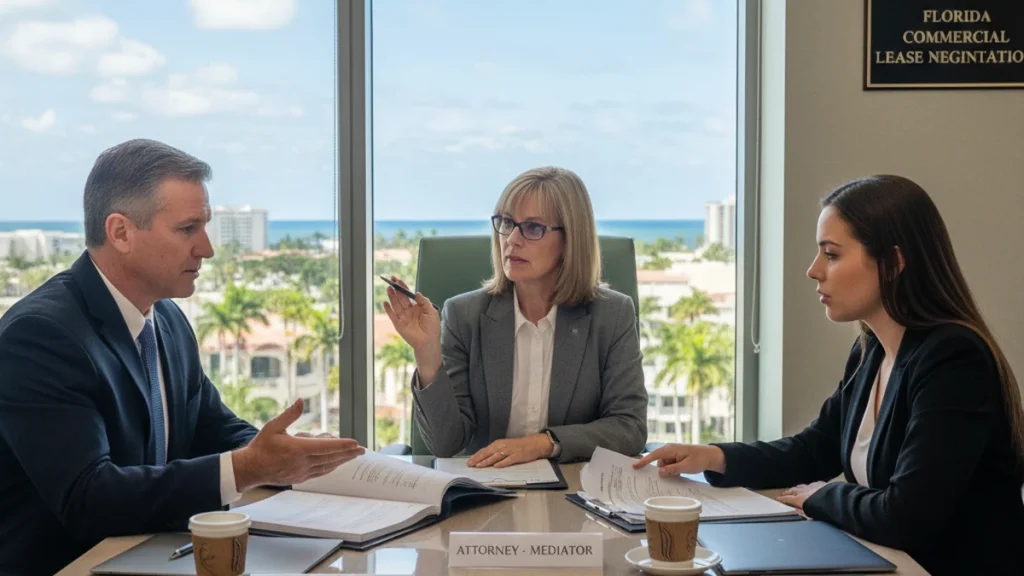
Commercial lease disputes often escalate to litigation when notice requirements are ignored.
What the Litigation Process Actually Looks Like
From Demand Letter to Trial
| Stage | What Happens | Typical Timeline |
|---|---|---|
| Pre-suit demand | Attorney sends formal demand citing the breach and demanding cure or payment | Days 1–14 |
| Filing & service | Complaint filed in circuit court; defendant has 20 days to respond | Weeks 2–4 |
| Discovery | Exchange of financials, lease communications, maintenance records | Months 2–6 |
| Mediation | Florida courts typically require mediation before trial | Months 4–8 |
| Trial or settlement | Most cases resolve at mediation; contested cases go to trial | Months 6–18+ |
Self-Help Eviction Is Not Allowed
Some landlords think they can change the locks or remove a tenant’s property when rent goes unpaid. Self-help eviction is prohibited in Florida even if your lease purports to allow it. A landlord who locks out a commercial tenant without a court order can face significant liability. The right path is through the courts — and with a proper three-day notice, the process moves faster than most people expect. Review the full Florida landlord-tenant statute if you want to see exactly what’s permitted.
Attorney Fees — A Huge Factor in How These Cases Resolve
Prevailing Party Clauses Cut Both Ways
Most well-drafted commercial leases include a prevailing party attorney fee clause. Under Florida law, if a contract provides for fees to one party, it applies to both. That means if you lose, you pay the other side’s attorney fees — and if you win, you can recover yours. This dynamic changes how both sides evaluate settlement at every stage of a Florida business litigation case.
Frequently Asked Questions
| Question | Answer |
|---|---|
| Can my landlord lock me out of my commercial space in Florida? | No. Self-help eviction is illegal in Florida regardless of what your lease says. The landlord must go through the court eviction process. |
| How long does a commercial eviction take in Florida? | Uncontested evictions can wrap up in 4–6 weeks after proper notice. Contested cases can take several months. |
| What if our lease has no dispute resolution clause? | Florida courts default to standard civil litigation procedures. Mediation may still be required by the court before trial. |
| Can I withhold rent if my landlord won’t make repairs? | This is risky without specific lease language authorizing it. Consult an attorney before withholding rent — it can trigger eviction proceedings. |
Stop Letting a Lease Dispute Drain Your Business
The longer a Florida commercial lease dispute goes unresolved, the more it costs both sides. Feinstein Law represents landlords and tenants in commercial lease litigation throughout Broward, Miami-Dade, and Palm Beach counties. Call (954) 767-9662 or contact us at our contact page.
About Feinstein Law: Feinstein Law is a Fort Lauderdale litigation firm handling business, real estate, and construction litigation throughout South Florida.