





 954-767-9662
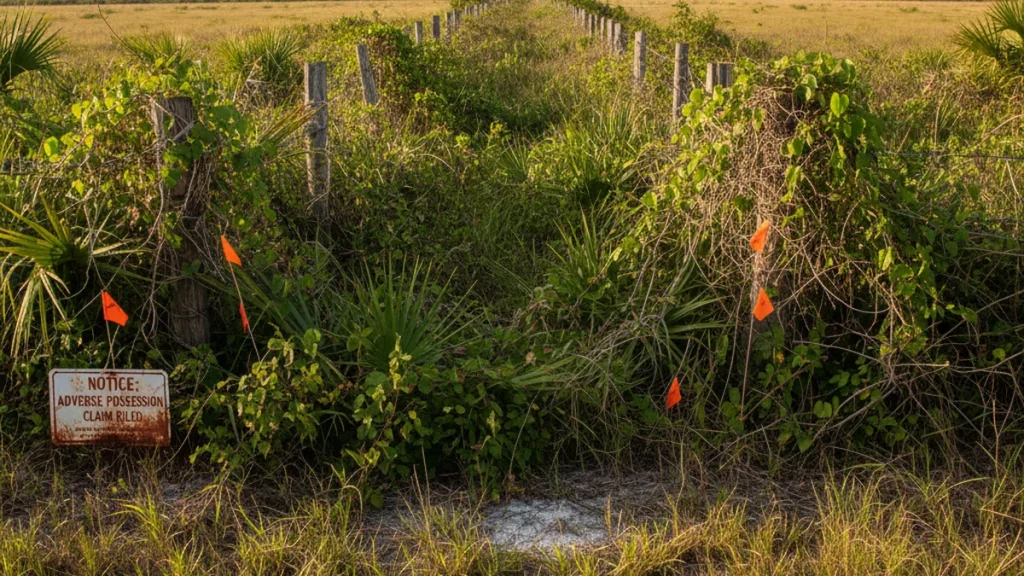
Florida adverse possession is a legal doctrine that allows a person who openly occupies someone else’s land for a continuous period to eventually claim legal ownership. It sounds alarming — and it should. Under Florida Statute § 95.18, a claimant who meets specific requirements can petition a court to transfer title away from the actual owner. Understanding adverse possession in Florida is the first step to protecting your property before a claim matures.
What Is Adverse Possession in Florida?
The Basic Legal Requirements
To succeed on a Florida adverse possession claim, the occupant must prove all five elements for a continuous period of at least 7 years:
- Actual possession — physically using the land (farming, building, landscaping)
- Open and notorious — visible use that a reasonable owner would notice
- Exclusive — not shared with the public or the true owner
- Hostile — without the owner’s permission
- Continuous — uninterrupted for the full statutory period
Florida also requires the claimant to pay all property taxes on the disputed parcel during the 7-year period. This tax payment requirement is one of the strictest in the country and disqualifies many would-be claimants. If you notice a neighbor using your land, contacting a Fort Lauderdale real estate litigation lawyer immediately can stop the clock.
How Adverse Possession Claims Start
The Most Common Scenarios in South Florida
Most adverse possession Florida cases begin quietly — a neighbor’s fence goes up a few feet over the property line, a driveway extends onto your land, or vegetation clears to reveal that someone has been gardening on your parcel for years. By the time the owner discovers it, years of “hostile” use may already have accrued.
| Scenario | Risk Level | Recommended Action |
|---|---|---|
| Neighbor’s fence over property line | High | Survey and written notice immediately |
| Shared driveway without agreement | Medium | Establish a written license or easement |
| Vacant lot being maintained by neighbor | High | Posted no-trespassing signs and legal notice |
| Old garden encroaching on your parcel | Medium-High | Survey and demand removal in writing |
| Abandoned structure on boundary | High | Quiet title action if unresolved within 1 year |
Color of Title Claims
Some claimants have a defective deed — a document that appears to convey title but contains an error. This is called “color of title.” Under Florida law, a color of title claimant can use their defective deed to strengthen the adverse possession claim, potentially affecting a larger area than they physically occupy. These cases are particularly aggressive and require an experienced real estate litigation attorney to counter.
How to Stop an Adverse Possession Claim
Interrupt Continuous Possession
The 7-year clock resets if you interrupt the occupant’s continuous possession. Legally effective interruptions include:
- Filing a lawsuit for trespass or ejectment
- Serving written notice demanding they vacate
- Granting a written license that converts hostile use to permissive use
- Physically reclaiming the land with the occupant’s knowledge
Verbal complaints do not interrupt the clock. Only documented legal action reliably resets the period. The Florida Bar recommends property owners conduct a boundary survey every 5–10 years to catch encroachments before they ripen into claims.
File a Quiet Title Action
If an occupant has already met the 7-year threshold, you may need to challenge the adverse possession claim directly in court. A quiet title action forces the claimant to prove every element. Missing even one — particularly the tax payment requirement — defeats the claim entirely. Florida courts have denied numerous adverse possession suits because claimants failed to consistently pay property taxes.
What Happens If a Claim Succeeds?
If a court finds that all elements are met, it issues a judgment transferring legal title to the adverse possessor. The original owner loses the property permanently with no compensation. This makes early intervention critical. The Florida Courts system processes these cases at the circuit court level, and judgments are recorded in the county property records — making the transfer fully enforceable.
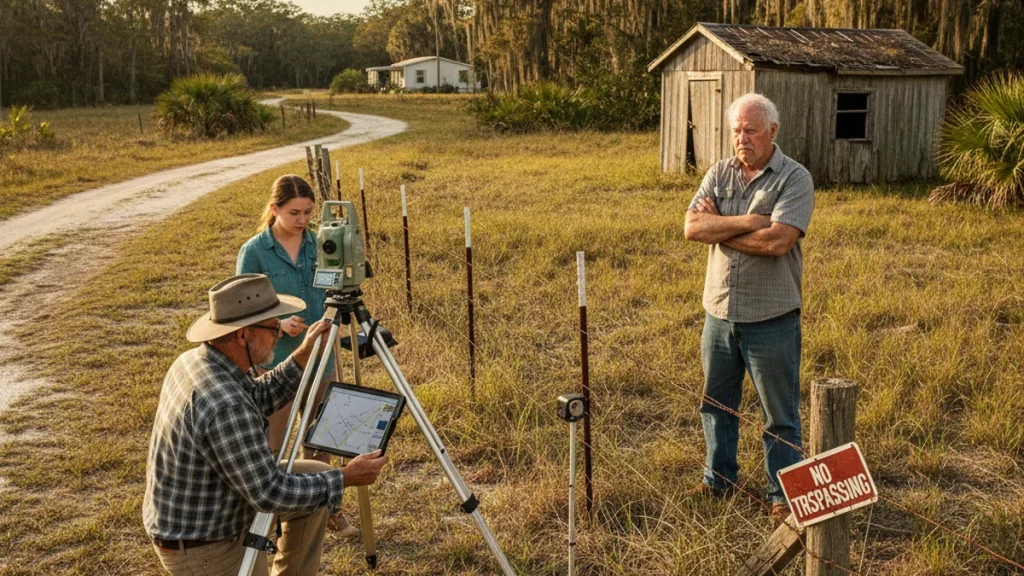 Accurate surveys are critical in adverse possession cases to establish continuous use.
Frequently Asked Questions
| Question | Answer |
|---|---|
| How long does adverse possession take in Florida? | 7 continuous years of qualifying possession, with property taxes paid throughout. |
| Can I grant permission to stop the clock? | Yes — written permission converts hostile use to permissive use, defeating the “hostile” element. |
| Does posting signs help? | Yes, posted no-trespassing signs establish that you are monitoring and asserting ownership. |
| What if the encroachment is minor? | Even small encroachments can mature into legal claims. Survey and address them in writing immediately. |
| Can a tenant adversely possess property? | Generally no — a tenant’s possession is permissive by definition, defeating the hostile element. |
Don’t Let a Neighbor’s Encroachment Become a Legal Claim
The longer you wait, the stronger a Florida adverse possession claim becomes. If you suspect someone is occupying your land without permission, Feinstein Real Estate Litigation & Business Law can assess the situation and take action before the 7-year period runs. Call (954) 767-9662 or reach us through our contact page for a consultation.
About Feinstein Real Estate Litigation & Business Law
Feinstein Real Estate Litigation & Business Law is a South Florida firm with over 37 years of experience in real estate disputes, quiet title actions, business litigation, and mediation. Serving Broward, Miami-Dade, and Palm Beach Counties.
