
Phone

HOA Disputes in Florida: What Homeowners Need to Know

Florida Adverse Possession: Can Someone Claim Your Property?

What Is a Quiet Title Action in Florida?

Defending Against a Lawsuit in Florida: What Happens After You’re Served

How Florida Courts Handle Breach of Partnership Agreements

Florida Real Estate Fraud: Warning Signs and Legal Remedies

What Is Tortious Interference in Florida Business Law?

How to Dispute a Mechanics Lien in Florida

Luxury Real Estate Purchase Agreements: Key Clauses to Review

Florida Breach of Fiduciary Duty: What Business Owners Need to Know

Call Now Email12
Florida's Business Law Firm
Fort Lauderdale Phone954-767-9662

HOA Disputes in Florida: What Homeowners Need to Know

Frustrated Florida homeowner reviewing HOA violation letter

HOA disputes in Florida are among the most common and most frustrating legal conflicts homeowners face. Whether you’re fighting an unfair fine, challenging a board decision, or dealing with a lien on your home, Florida’s community association laws give homeowners real rights — but only if you know how to use them. This guide explains what Florida HOA disputes look like, what the law says, and when you need a real estate attorney in your corner.

Common Types of HOA Disputes in Florida

Fines and Assessment Disputes

HOAs have the authority to levy fines for violations of community rules, but Florida law limits how and when they can do so. Under Florida Statute § 720.305, an HOA cannot fine a member more than $100 per violation per day, with a cap of $1,000 per violation unless the governing documents allow more. Before imposing a fine, the HOA must give proper notice and an opportunity to be heard before a fining committee.

Lien and Foreclosure Threats

An HOA can place a lien on your property for unpaid assessments and, in some cases, foreclose on that lien. This is one of the most aggressive collection tools available to a community association — and one of the most legally regulated. If you receive a lien notice or a foreclosure threat over HOA dues, contact a Fort Lauderdale real estate litigation attorney before responding.

Board Misconduct and Transparency Issues

Florida’s Homeowners Association Act (Chapter 720) requires boards to hold open meetings, maintain financial records, and allow member inspection of documents. When boards act without transparency — holding secret meetings, denying record requests, or self-dealing on contracts — homeowners have legal recourse including petitioning the Division of Florida Condominiums, Timeshares, and Mobile Homes or filing suit directly.

Your Rights as a Florida HOA Member

Right Legal Basis How to Enforce
Inspect association records F.S. § 720.303(5) Written request; board must respond within 10 business days
Attend board meetings F.S. § 720.303(2) All meetings must be properly noticed; members may attend
Challenge fines before a committee F.S. § 720.305 Demand a fining committee hearing before paying
Vote to recall board members F.S. § 720.303(10) Petition with enough member signatures triggers recall election
Request alternative dispute resolution F.S. § 720.311 Pre-suit mediation required for most HOA disputes

Mandatory Pre-Suit Mediation

Before filing most lawsuits against an HOA in Florida, state law requires you to attempt pre-suit mediation. This is not optional — skipping it can get your case dismissed. An experienced business litigation attorney who also handles HOA matters can guide you through this process efficiently and position you for litigation if mediation fails.

When Should You Hire an Attorney for an HOA Dispute?Florida HOA dispute attorney representing property owner in real estate litigation

  • The HOA has placed or threatened a lien on your home
  • You received a notice of foreclosure over unpaid assessments
  • The board denied a legitimate record inspection request
  • You have been fined without proper notice or a hearing
  • The HOA is selectively enforcing rules against you
  • A board member has a conflict of interest in a vote that affected you

The Florida Bar’s guidance on community association law confirms that homeowners often underestimate how much leverage they have when boards fail to follow proper procedures. A single procedural error by the HOA — like missing the fining committee step — can invalidate an entire enforcement action.

Condo Association vs. HOA: Different Rules

Florida condominiums are governed by the Condominium Act (Chapter 718), which has different rules than the HOA Act. Condo owners have stricter inspection rights, different meeting requirements, and different dispute resolution pathways. If your dispute involves a condo association rather than a traditional HOA, the legal strategy differs. A West Lauderdale real estate litigation attorney familiar with both statutes can advise on the correct approach.

Frequently Asked Questions

Question Answer
Can an HOA really foreclose on my home in Florida? Yes, but only after following strict legal procedures including notice, lien recording, and a cure period.
What is the maximum fine an HOA can charge in Florida? $100/day per violation up to $1,000 total, unless governing documents authorize more.
Can I sue my HOA directly? Yes, but Florida law requires pre-suit mediation for most disputes before a lawsuit can be filed.
What records am I entitled to inspect? Financial records, meeting minutes, contracts, and governing documents — all within 10 business days of a written request.
What if the HOA ignores my record request? You may file a complaint with the DBPR or pursue legal action for non-compliance.

Fighting Back Starts with Knowing Your Rights

An HOA has significant power — but that power has limits under Florida law. If your HOA dispute in Florida has escalated beyond what you can handle alone, Feinstein Real Estate Litigation & Business Law can step in. Call (954) 767-9662 or visit our contact page to discuss your situation.

About Feinstein Real Estate Litigation & Business Law

Feinstein Real Estate Litigation & Business Law is a South Florida law firm with over 37 years of experience handling HOA disputes, real estate litigation, breach of contract, and business law matters throughout Broward, Miami-Dade, and Palm Beach Counties.

By : Michael Feinstein | April 20, 2026 | Real Estate Law

Florida Adverse Possession: Can Someone Claim Your Property?

Florida property boundary fence line with survey markers — adverse possession

Florida adverse possession is a legal doctrine that allows a person who openly occupies someone else’s land for a continuous period to eventually claim legal ownership. It sounds alarming — and it should. Under Florida Statute § 95.18, a claimant who meets specific requirements can petition a court to transfer title away from the actual owner. Understanding adverse possession in Florida is the first step to protecting your property before a claim matures.

What Is Adverse Possession in Florida?

The Basic Legal Requirements

To succeed on a Florida adverse possession claim, the occupant must prove all five elements for a continuous period of at least 7 years:

  • Actual possession — physically using the land (farming, building, landscaping)
  • Open and notorious — visible use that a reasonable owner would notice
  • Exclusive — not shared with the public or the true owner
  • Hostile — without the owner’s permission
  • Continuous — uninterrupted for the full statutory period

Florida also requires the claimant to pay all property taxes on the disputed parcel during the 7-year period. This tax payment requirement is one of the strictest in the country and disqualifies many would-be claimants. If you notice a neighbor using your land, contacting a Fort Lauderdale real estate litigation lawyer immediately can stop the clock.

How Adverse Possession Claims Start

The Most Common Scenarios in South Florida

Most adverse possession Florida cases begin quietly — a neighbor’s fence goes up a few feet over the property line, a driveway extends onto your land, or vegetation clears to reveal that someone has been gardening on your parcel for years. By the time the owner discovers it, years of “hostile” use may already have accrued.

Scenario Risk Level Recommended Action
Neighbor’s fence over property line High Survey and written notice immediately
Shared driveway without agreement Medium Establish a written license or easement
Vacant lot being maintained by neighbor High Posted no-trespassing signs and legal notice
Old garden encroaching on your parcel Medium-High Survey and demand removal in writing
Abandoned structure on boundary High Quiet title action if unresolved within 1 year

Color of Title Claims

Some claimants have a defective deed — a document that appears to convey title but contains an error. This is called “color of title.” Under Florida law, a color of title claimant can use their defective deed to strengthen the adverse possession claim, potentially affecting a larger area than they physically occupy. These cases are particularly aggressive and require an experienced real estate litigation attorney to counter.

How to Stop an Adverse Possession Claim

Interrupt Continuous Possession

The 7-year clock resets if you interrupt the occupant’s continuous possession. Legally effective interruptions include:

  • Filing a lawsuit for trespass or ejectment
  • Serving written notice demanding they vacate
  • Granting a written license that converts hostile use to permissive use
  • Physically reclaiming the land with the occupant’s knowledge

Verbal complaints do not interrupt the clock. Only documented legal action reliably resets the period. The Florida Bar recommends property owners conduct a boundary survey every 5–10 years to catch encroachments before they ripen into claims.

File a Quiet Title Action

If an occupant has already met the 7-year threshold, you may need to challenge the adverse possession claim directly in court. A quiet title action forces the claimant to prove every element. Missing even one — particularly the tax payment requirement — defeats the claim entirely. Florida courts have denied numerous adverse possession suits because claimants failed to consistently pay property taxes.

What Happens If a Claim Succeeds?

If a court finds that all elements are met, it issues a judgment transferring legal title to the adverse possessor. The original owner loses the property permanently with no compensation. This makes early intervention critical. The Florida Courts system processes these cases at the circuit court level, and judgments are recorded in the county property records — making the transfer fully enforceable.

Florida surveyor measuring disputed property boundaryAccurate surveys are critical in adverse possession cases to establish continuous use.

Frequently Asked Questions

Question Answer
How long does adverse possession take in Florida? 7 continuous years of qualifying possession, with property taxes paid throughout.
Can I grant permission to stop the clock? Yes — written permission converts hostile use to permissive use, defeating the “hostile” element.
Does posting signs help? Yes, posted no-trespassing signs establish that you are monitoring and asserting ownership.
What if the encroachment is minor? Even small encroachments can mature into legal claims. Survey and address them in writing immediately.
Can a tenant adversely possess property? Generally no — a tenant’s possession is permissive by definition, defeating the hostile element.

Don’t Let a Neighbor’s Encroachment Become a Legal Claim

The longer you wait, the stronger a Florida adverse possession claim becomes. If you suspect someone is occupying your land without permission, Feinstein Real Estate Litigation & Business Law can assess the situation and take action before the 7-year period runs. Call (954) 767-9662 or reach us through our contact page for a consultation.

About Feinstein Real Estate Litigation & Business Law

Feinstein Real Estate Litigation & Business Law is a South Florida firm with over 37 years of experience in real estate disputes, quiet title actions, business litigation, and mediation. Serving Broward, Miami-Dade, and Palm Beach Counties.

By : Michael Feinstein | April 19, 2026 | Real Estate Law

What Is a Quiet Title Action in Florida?

Florida quiet title action property deed and gavel on attorney desk

A quiet title action in Florida is a lawsuit filed to establish clear, undisputed ownership of real property. When ownership is clouded by competing claims, liens, or gaps in the chain of title, buyers, lenders, and owners cannot move forward with confidence. Filing a Florida quiet title action removes those clouds so that the title is clean and marketable. Understanding this process protects your investment before disputes escalate into costly litigation.

What Does “Quieting Title” Actually Mean?

Establishing Legal Ownership on Record

When a court “quiets” title, it issues a final judgment declaring who the rightful owner is. That judgment is recorded in the public record, permanently silencing any adverse claims. Florida courts handle these actions under Florida Statute § 65.021, which outlines the grounds and procedures for bringing a quiet title suit.

Common Reasons Title Becomes Clouded

  • Errors in a prior deed — wrong legal description or misspelled name
  • Unrecorded interests from a prior owner’s heirs
  • Fraudulent or forged conveyances
  • Tax deed sales that did not follow proper notice procedures
  • Boundary disputes with adjacent property owners
  • Adverse possession claims by a longtime occupant

Any one of these issues can block a sale or refinance. A Fort Lauderdale real estate litigation lawyer can assess which issue applies and how aggressively it needs to be addressed.

When Do You Need a Quiet Title Action in Florida?

After Purchasing a Tax Deed Property

Tax deed purchases are among the most common triggers for a quiet title action Florida filing. When a county sells a property for unpaid taxes, prior lienholders and heirs of former owners may still assert claims. A quiet title action puts all potential claimants on notice and eliminates their interests if they fail to respond.

After Acquiring Property Through Foreclosure or Probate

Foreclosure sales and probate transfers often leave title defects. Missing heirs, unsatisfied junior liens, or improperly noticed creditors can resurface years later. Filing a Florida quiet title lawsuit closes those gaps decisively. According to the Florida Bar Journal, quiet title actions are especially critical after non-judicial transfers where court oversight was limited.

Resolving Boundary and Encroachment Disputes

Neighbors who have used a strip of your land for decades may eventually assert an adverse possession claim. A quiet title action establishes your boundary legally before that claim matures. Early action is always less expensive than defending a full adverse possession lawsuit.

How the Quiet Title Process Works in Florida

Stage What Happens Typical Timeframe
Title Search Attorney identifies all clouds, liens, and competing claims 1–2 weeks
Complaint Filed Lawsuit filed in circuit court naming all potential claimants Week 2–3
Service of Process All defendants served; publication notice for unknown claimants 4–8 weeks
Default or Response Defendants either respond or default is entered Weeks 8–16
Final Judgment Court issues judgment quieting title in your favor Months 4–6
Recording Judgment recorded in county property records 1–2 days after judgment

Publication Notice for Unknown Claimants

Florida law requires publishing notice in a local newspaper when defendants cannot be personally served. This puts unknown heirs and interest holders on notice. The Florida publication statute governs the frequency and format of this notice. Skipping or botching this step can void the entire judgment.

Quiet Title vs. Title Insurance: What’s the Difference?

Title Insurance Covers Future Claims — It Doesn’t Eliminate Them

Title insurance indemnifies you if a covered claim surfaces later. It does not remove the cloud from the record. A quiet title action in Florida actually eliminates the defect, making the title insurable and marketable going forward. Lenders almost always require clean title before funding a purchase or refinance.

When You Need Both

After a successful quiet title action, most owners purchase a new title insurance policy. The clean judgment gives the insurer confidence, and the policy protects against any claims that may have been missed. Your real estate litigation attorney can coordinate with your title company to make the transition seamless.

Costs and Realistic Expectations

  • Uncontested cases: typically $1,500–$4,000 in attorney fees plus court costs
  • Contested cases: fees rise significantly depending on the number of defendants and complexity
  • Timeline: 3–6 months for uncontested; 12+ months if defendants actively litigate
  • Result: a recorded final judgment that clears the cloud permanently

The Florida Realtors confirm that title defects are among the leading causes of delayed or collapsed real estate closings in South Florida. Addressing them proactively is almost always cheaper than losing a sale.

Attorney reviewing Florida property title chain of ownershipA quiet title attorney reviews the chain of ownership to identify competing claims.

Frequently Asked Questions

Question Answer
How long does a quiet title action take in Florida? Uncontested cases typically resolve in 3–6 months. Contested cases can take over a year.
Do I need an attorney to file a quiet title action? Technically no, but the procedural requirements — publication, proper service, court filings — make attorney representation essential in practice.
Can a quiet title action remove a lien? Yes, if the lienholder is named and properly served. Certain statutory liens (like IRS liens) require separate federal proceedings.
What happens if a defendant contests the action? The case proceeds as contested litigation. A judge or jury ultimately determines ownership based on evidence and legal arguments.
Is a quiet title action the same as a title search? No. A title search identifies defects. A quiet title action is the legal proceeding that eliminates them.

Clear Title Starts with the Right Attorney

A clouded title does not fix itself. The longer you wait, the more claimants can appear and the harder it becomes to establish clean ownership. If you are facing a quiet title action in Florida — or suspect your title has a defect — Feinstein Real Estate Litigation & Business Law can clear it. Call (954) 767-9662 or visit our contact page to schedule a consultation today.

About Feinstein Real Estate Litigation & Business Law

Feinstein Real Estate Litigation & Business Law is a South Florida firm with over 37 years of experience resolving complex real estate and business disputes. Serving Fort Lauderdale, Broward County, Miami-Dade, and Palm Beach, the firm handles quiet title actions, breach of contract, commercial litigation, mediation, and more.

By : Michael Feinstein | April 18, 2026 | Real Estate Law

Defending Against a Lawsuit in Florida: What Happens After You’re Served

Florida defendant served with lawsuit — process server at door

If you just got served with a lawsuit in Florida, you’re probably feeling the pressure of not knowing what happens next or how serious this actually is. Here’s the short version: it’s serious, the clock started the moment those papers were handed to you, and the decisions you make in the next 20 days will affect everything that follows. Defending against a lawsuit in Florida requires understanding what you’re being served, what your obligations are, and which moves preserve your defenses — and which ones destroy them.

What Happens the Moment You’re Served

The 20-Day Clock Is Real

Under Florida’s Rules of Civil Procedure, you have 20 days from the date of service to file a response. Not 30. Not whenever you get around to hiring an attorney. Twenty days — and that includes weekends. If you miss it, the plaintiff can move for a default, and a default judgment can be entered against you without any hearing on the merits. That means they win automatically. Getting a default set aside after the fact is possible but costly and not guaranteed.

How Service of Process Works in Florida

  • Personal service — process server hands documents directly to you
  • Substitute service — documents left with a resident of your household who is 15 or older
  • Registered agent service — for corporations, LLCs, and other business entities
  • Service by publication — used when you genuinely can’t be located; rare in business disputes

The date on the process server’s return of service is what starts your clock — not the date you actually read the complaint. If documents were left at your house and you were traveling, you still have 20 days from the date of service, not the date you returned home.

The First Things You Should Do — and Not Do

Florida attorney reviewing formal legal complaint document

Do This Immediately

  • Note the exact date you were served and count your 20-day response window starting from that date
  • Preserve everything related to the dispute — emails, texts, contracts, invoices, photos. Do not delete a single thing.
  • Notify your insurance carrier if you have commercial general liability, professional liability, or D&O coverage. Many policies require prompt notice or they can deny coverage.
  • Contact a Florida litigation attorney — ideally within the first 48 hours

Do Not Do This

  • Do not contact the plaintiff directly or try to work it out yourself — anything you say can and will be used against you
  • Do not ignore the complaint hoping it goes away — it won’t, and you’ll lose by default
  • Do not delete emails, texts, or files — that’s spoliation of evidence and can result in sanctions

Your Response Options After Being Served in Florida

What You Can File Within 20 Days

Response Type When to Use It
Answer The standard response — admit, deny, or state lack of knowledge as to each allegation
Motion to Dismiss Challenge the legal sufficiency of the complaint — argue it fails to state a valid claim even if everything alleged is true
Motion for More Definite Statement When the complaint is so vague you can’t reasonably frame a response
Counterclaim Assert your own claims against the plaintiff in the same lawsuit — this is common in Florida contract disputes
Third-Party Complaint Bring in additional parties who share responsibility for the plaintiff’s claims

Extensions Are Possible — But Not Automatic

If you need more than 20 days, your attorney can contact opposing counsel and request a written extension. Most attorneys grant reasonable extensions as a professional courtesy. But you cannot simply assume an extension will be granted — if the plaintiff’s attorney refuses and you haven’t filed anything, you’re in default. Get an attorney involved before day 10, not day 19.

Common Defenses in Florida Civil Litigation

What Your Attorney Will Evaluate First

  • Statute of limitations — was the lawsuit filed too late under Florida law?
  • Lack of standing — does the plaintiff actually have the legal right to bring this claim?
  • Failure of consideration — in contract disputes, did the plaintiff perform their obligations?
  • Comparative fault — in negligence cases, was the plaintiff partly responsible?
  • Accord and satisfaction — was there a prior settlement that resolved this dispute?

Florida’s Rules of Civil Procedure require most affirmative defenses to be raised in the initial answer or they may be waived. This is one of the main reasons you need a Florida litigation attorney involved from the start — not just to file something, but to file the right things. Review Florida’s civil procedure rules if you want to understand the full procedural framework.

What Happens After You Respond

The Litigation Timeline in Florida Circuit Court

Phase What Happens Approximate Timeline
Response filed Answer or motion filed; case management conference set Within 20 days of service
Discovery Document requests, depositions, interrogatories exchanged Months 2–8
Summary judgment motions Either party can ask the court to rule without trial on legal issues Months 6–12
Mediation Florida courts typically require mediation before trial in real estate and business cases Months 8–14
Trial Most cases settle before here; contested cases go to trial Months 12–24+

Frequently Asked Questions

Question Answer
What happens if I miss the 20-day deadline in Florida? The plaintiff can move for a clerk’s default, then a default judgment. You must act immediately to set it aside — and courts require a showing of good cause and a meritorious defense.
Can I negotiate a settlement after being served? Yes — at any point. But you still must respond to the lawsuit within 20 days unless you get a written extension from the plaintiff’s attorney.
Does being served mean I’m going to trial? Almost certainly not. The vast majority of Florida civil cases resolve before trial — often at mediation or through negotiated settlement.

You Have 20 Days — Don’t Lose Your Defenses by Default

If you’ve been served with a Florida lawsuit, the next step isn’t panic — it’s calling an attorney today. Feinstein Law defends clients in business litigation, real estate disputes, and contract matters throughout South Florida. Call (954) 767-9662 or reach us at our contact page.

About Feinstein Law: Feinstein Law is a Fort Lauderdale litigation firm representing defendants and plaintiffs in civil litigation throughout Broward, Miami-Dade, and Palm Beach counties.

By : Michael Feinstein | April 17, 2026 | Business Litigation

How Florida Courts Handle Breach of Partnership Agreements

Florida partnership agreement breach — attorneys at conference table

If your business partner has stopped showing up, started a competing company on the side, or is making decisions that benefit themselves at the expense of the partnership — you’re facing a breach of a Florida partnership agreement, and it needs to be addressed before the damage compounds. Florida partnership agreement breaches can destabilize a business built over years, and the legal outcomes depend heavily on what your written agreement says, what Florida’s default statutes provide when it’s silent, and how quickly the non-breaching partner acts.

What Florida Law Governs Your Partnership

The Right Statute Depends on Your Entity Type

Florida has separate statutes governing different types of partnerships, and knowing which one applies changes your options significantly:

These statutes provide default rules — but a well-drafted partnership agreement can modify most of them. If your partnership has no written agreement at all, Florida’s defaults kick in: equal profit sharing, equal management rights — which creates constant friction when partners have different expectations. A Florida business litigation attorney will review both the agreement and the applicable statute to identify where your partner went wrong.

If There’s No Written Agreement

You’re not without options, but you’re in a harder position. Without a written agreement specifying buyout procedures, management rights, or non-compete obligations, every dispute becomes a factual argument about what the partners actually intended. That’s expensive to litigate and unpredictable to win.

What Partner Conduct Actually Constitutes a Breach

Florida business litigation settlement — partners reaching agreement

The Breaches That Trigger Litigation Most Often

  • Withdrawing partnership funds without authorization or proper documentation
  • Competing directly against the partnership while still a member or general partner
  • Refusing to contribute agreed capital or perform promised duties
  • Making binding commitments on behalf of the partnership without authority
  • Disclosing confidential business information or trade secrets to competitors
  • Blocking a partner’s buyout rights or refusing to honor the agreed valuation method

These aren’t just business disagreements — they’re legally actionable breaches. If your partner is doing any of these things, the longer you wait, the more damage they can do and the harder it becomes to document what happened. Start preserving emails, financial records, and communications now, before you approach them or file anything.

What Remedies Are Available When a Florida Partner Breaches

Your Options Range From Money to Dissolution

Remedy What It Does
Damages Financial recovery for losses the breach caused — lost profits, diverted revenue, business value reduction
Accounting Court-ordered financial review to identify misappropriated funds or unauthorized distributions
Injunction Emergency order blocking the partner from accessing accounts, soliciting clients, or continuing to compete
Buyout Court-ordered or negotiated buyout of the breaching partner’s interest using the agreement’s valuation formula
Judicial dissolution Florida courts can dissolve the partnership entirely when continued operation is not reasonably practicable

The Role of Your Partnership Agreement in CourtFlorida breach of fiduciary duty — business litigation attorney

Florida courts enforce partnership agreements as written. If your agreement has a specific buyout formula, a non-compete obligation, or a dispute resolution clause requiring mediation first — courts will hold both parties to it. If the agreement requires a certain valuation method for a departing partner’s interest, that method controls unless it produces a manifestly unfair result. Your Florida contract dispute attorney needs to know every relevant clause before the first letter goes out.

Acting Quickly Is the Difference Between Recovery and Loss

Why Speed Matters in Florida Partnership Disputes

A partner who is in breach usually knows it. The moment they sense a dispute is coming, they may start moving assets, accelerating side deals, or manipulating financial records. Emergency injunctive relief is available in Florida when ongoing harm is being caused — but you have to move before the damage is done, not after. The American Bar Association’s mediation resources outline when pre-litigation resolution actually works — and in partnership disputes, early intervention often produces better outcomes than waiting for full litigation.

Frequently Asked Questions

Question Answer
Can I force a partner out of a Florida partnership for breaching the agreement? Yes. Florida law allows judicial dissolution or expulsion when a partner’s wrongful conduct makes continued operation impracticable.
How long do I have to sue a Florida partner for breach? 5 years for a written agreement breach; 4 years for other business torts. The clock starts when the breach occurred or was discovered.
What if my partner claims I also breached the agreement? Cross-claims and counterclaims are standard in partnership disputes. Having clean documentation of your own conduct is essential before filing.

Protect What You Built — Your Florida Partnership Has Legal Remedies

A Florida partnership agreement breach doesn’t fix itself with time — it gets worse. Feinstein Law represents business owners in partnership disputes and breach of contract litigation throughout South Florida. Call (954) 767-9662 or contact us through our contact page.

About Feinstein Law: Feinstein Law is a Fort Lauderdale litigation firm focused on business, contract, and real estate disputes throughout Broward, Miami-Dade, and Palm Beach counties.

By : Michael Feinstein | April 16, 2026 | Business Litigation

Florida Real Estate Fraud: Warning Signs and Legal Remedies

Florida real estate fraud — warning signs and legal remedies

If you’re reading this after a Florida real estate deal went wrong — a seller who hid water damage, a closing where the wire instructions changed at the last minute, or a title search that revealed deeds you never knew about — you’re dealing with something that costs Florida buyers and sellers millions of dollars every year. Florida real estate fraud comes in more forms than most people realize, and the legal remedies available depend heavily on which type occurred and how quickly you act. Here’s what you’re actually dealing with and what your options are.

The Most Common Types of Florida Real Estate Fraud

Property Condition Misrepresentation

This is the most frequent form. Florida law requires sellers to disclose known material defects that aren’t readily observable and that could affect the property’s value — a duty established by the Florida Supreme Court in Johnson v. Davis. When a seller conceals water damage, past flooding, mold, foundation issues, or prior insurance claims, they’re not just being dishonest — they’re creating liability. If you discovered a problem after closing that the seller clearly knew about, you may have a strong Florida real estate litigation claim.

Wire Fraud at ClosingFlorida commercial real estate closing — attorney and title agent


This has become the fastest-growing real estate fraud problem in Florida. Criminals intercept email communications between buyers, attorneys, and title companies — then send fraudulent wiring instructions directing closing funds to their own accounts. Once the money is wired, it’s almost never recovered. The rule is simple: always verify wire transfer instructions by phone, using a number you independently confirmed — not one from an email. The FBI’s Internet Crime Complaint Center (IC3) tracks these cases nationally — Florida consistently ranks among the highest-loss states.

Title Fraud and Forged Deeds

Title fraud involves forged deeds or fraudulent transfers that cloud ownership of a property or outright steal it. South Florida has seen cases where vacant properties or properties owned by out-of-state investors were fraudulently transferred and then listed for sale — sometimes successfully. A thorough title search and title insurance are your first lines of defense, but they don’t catch everything. If you’ve discovered an unauthorized deed transfer, contact a Florida real estate attorney immediately — there are emergency legal remedies available.

Warning Signs Before and During a Florida Real Estate Transaction

Red Flags That Should Stop You in Your Tracks

Red Flag What It Likely Means
Pressure to close quickly without full inspection time Seller trying to prevent discovery of concealed defects
Last-minute change to wire transfer instructions via email High probability of wire fraud — verify immediately by phone
Property sold multiple times in quick succession at escalating prices Possible flip fraud or money laundering
Seller refuses to provide a complete seller’s disclosure Red flag for known defects or prior litigation
Title shows recent deed changes, gaps in ownership, or multiple liens Possible title fraud or undisclosed encumbrances

Your Legal Remedies After Florida Real Estate Fraud

Rescission

Rescission unwinds the entire transaction — both parties return to their pre-contract positions. This is the remedy buyers most often want when they discover fraud after closing on a defective property. It requires showing the fraud was material and that you would not have entered the transaction if you’d known the truth. This is exactly the kind of claim a Florida real estate litigation attorney will evaluate first.

Damages, Civil Theft, and Punitive Awards

  • Compensatory damages — out-of-pocket losses, repair costs, diminution in value
  • Civil theft treble damages — Florida’s civil theft statute, § 772.11, allows recovery of three times actual damages in qualifying fraud cases
  • Punitive damages — available when fraud was intentional and egregious
  • Attorney fees — recoverable under civil theft and some fraud theories

Can You Sue the Real Estate Agent?

Yes — and this surprises many people. Agents have independent disclosure duties and can be held personally liable for fraud or negligent misrepresentation separate from the seller. If your agent knew about a defect, failed to disclose it, or actively helped conceal it, they can be named as a defendant in your Florida fraud claim.

Frequently Asked Questions

Question Answer
How long do I have to sue for real estate fraud in Florida? 4 years from the date the fraud was discovered or should have been discovered. Don’t wait — evidence disappears and defendants move assets.
Is every seller non-disclosure fraud in Florida? No. Only when the seller knew about a material defect, it wasn’t observable, and they failed to disclose it. Honest oversights aren’t fraud.
What if the wire fraud happened — can I get the money back? Recovery is rare but possible if reported immediately. Contact your bank, the receiving bank, and the FBI’s IC3 within hours of discovery.

Florida Real Estate Fraud Victims Have More Options Than They Know

If you suspect Florida real estate fraud was involved in your transaction, the window to act matters. Feinstein Law represents buyers, sellers, and investors in real estate fraud cases throughout South Florida. Call (954) 767-9662 or visit our contact page.

About Feinstein Law: Feinstein Law is a Fort Lauderdale firm focused on real estate litigation, business disputes, and construction law in Broward, Miami-Dade, and Palm Beach counties.
By : Michael Feinstein | April 15, 2026 | Real Estate Litigation

What Is Tortious Interference in Florida Business Law?

Florida tortious interference — business litigation attorney

If a competitor is spreading false information about your business, a former partner is contacting your clients to steer them away, or someone pressured your supplier to cut off your contract — you’re probably experiencing what Florida law calls tortious interference. Tortious interference in Florida is a business tort that holds third parties liable when they deliberately disrupt your contracts or business relationships. It’s one of the most useful tools Florida business owners have against bad actors who operate just outside of direct breach of contract — but it has specific elements you have to prove.

The Two Types of Tortious Interference Florida Recognizes

Interference with an Existing ContractFlorida tortious interference — business litigation attorney

This is the cleaner claim. You had a valid, enforceable contract with a third party. The defendant knew about it. They intentionally caused the other party to breach it. You suffered damages as a result. When all four line up, you have a strong Florida tortious interference claim. Courts don’t require you to prove the defendant used improper means — intentional interference with a known contract is enough.

Interference with a Prospective Business Relationship

This is harder to prove, but it covers situations where there was no signed contract yet — just a deal that was moving toward closing, a customer relationship that was ongoing, or a business opportunity that was being developed. Here, Florida courts require you to show the defendant’s conduct was improper — not just that they competed aggressively. Courts look at the defendant’s motive, the methods used, and whether those methods cross ethical or legal lines. A Florida business litigation attorney can help you assess which version of the claim you’re working with.

What You Have to Prove — Element by Element

The Full Checklist

Element What It Means for Your Case
Existence of a contract or relationship A valid contract or a specific, identifiable business relationship — not just general goodwill
Defendant’s knowledge They knew the contract or relationship existed — this is usually not hard to prove in business contexts
Intentional interference They acted deliberately — negligent interference doesn’t count in Florida
Causation Their interference actually caused the contract to be breached or the relationship to end
Damages You suffered real, quantifiable economic harm — lost contracts, lost revenue, lost customers

The Evidence That Usually Makes or Breaks It

The causation element is where most Florida tortious interference claims succeed or fail. You need to show the defendant’s actions — not some other factor — were the reason the business relationship ended. Email communications, text messages, testimony from the third party about what they were told, and timing evidence are all critical. Start preserving everything now if you suspect interference is happening.

Real Examples of Tortious Interference in Florida Business DisputesFlorida business litigation attorney fees — fee agreement review

Patterns That Show Up Most Often

  • A competitor contacts your key clients and tells them — falsely — that your company is going out of business or facing legal trouble
  • A former business partner reaches out to your supplier and convinces them to breach their supply agreement with you
  • An investor provides false information to the other party in a deal you were about to close, causing them to walk away
  • A former employee violates their non-solicitation agreement by contacting your customer list and actively steering clients to their new employer
  • A third party pressures a joint venture partner to withdraw from a signed agreement

The Competition Privilege — Their Main Defense

What It Covers

Not everything that hurts your business is tortious interference. Florida recognizes the competition privilege — the right to compete fairly for business, even aggressively. Winning a contract away from a competitor through better pricing, faster service, or a better product is not tortious interference. The line is drawn at improper means: false statements, threats, misuse of confidential information, or conduct that violates independent legal standards. Expect this defense in any Florida business tort case.

What Doesn’t Get the Competition Privilege

  • Spreading false information about a competitor’s business
  • Using confidential information obtained from the competitor’s former employees
  • Making threats or using economic coercion to pressure a third party to breach
  • Inducing breach of a known contract — not just winning business away from one

Courts look at the totality of conduct. One aggressive move might get the privilege; a pattern of coordinated interference usually doesn’t. See the Cornell Law overview of tortious interference for the national legal framework and how Florida fits within it.

What Damages Are Available

Damage Type Description
Lost profits Revenue from the specific contract or relationship that was disrupted
Consequential business losses Downstream effects — lost follow-on business, reputational harm with measurable impact
Punitive damages Available when conduct was intentional and particularly egregious — requires clear and convincing evidence of malice

Frequently Asked Questions

Question Answer
Can I sue a competitor for tortious interference in Florida? Yes — if they used improper means, not just aggressive competition. The key is whether they crossed from competing into interfering.
Do I need a written contract? No. Florida protects prospective business relationships that haven’t produced a signed contract yet — though the claim is harder to prove.
How quickly should I act? Immediately. Evidence disappears, witnesses’ memories fade, and the four-year statute of limitations starts running from the date of interference — not when you discovered it.

Someone Crossed the Line — Florida Law Gives You a Path Forward

If a competitor or third party has deliberately disrupted your Florida business relationships, Feinstein Law handles tortious interference claims and Florida business litigation throughout South Florida. Call (954) 767-9662 or reach us at our contact page.

About Feinstein Law: Feinstein Law is a Fort Lauderdale firm handling commercial disputes, contract claims, and real estate litigation throughout Broward, Miami-Dade, and Palm Beach counties.

By : Michael Feinstein | April 14, 2026 | Business Litigation

How to Dispute a Mechanics Lien in Florida

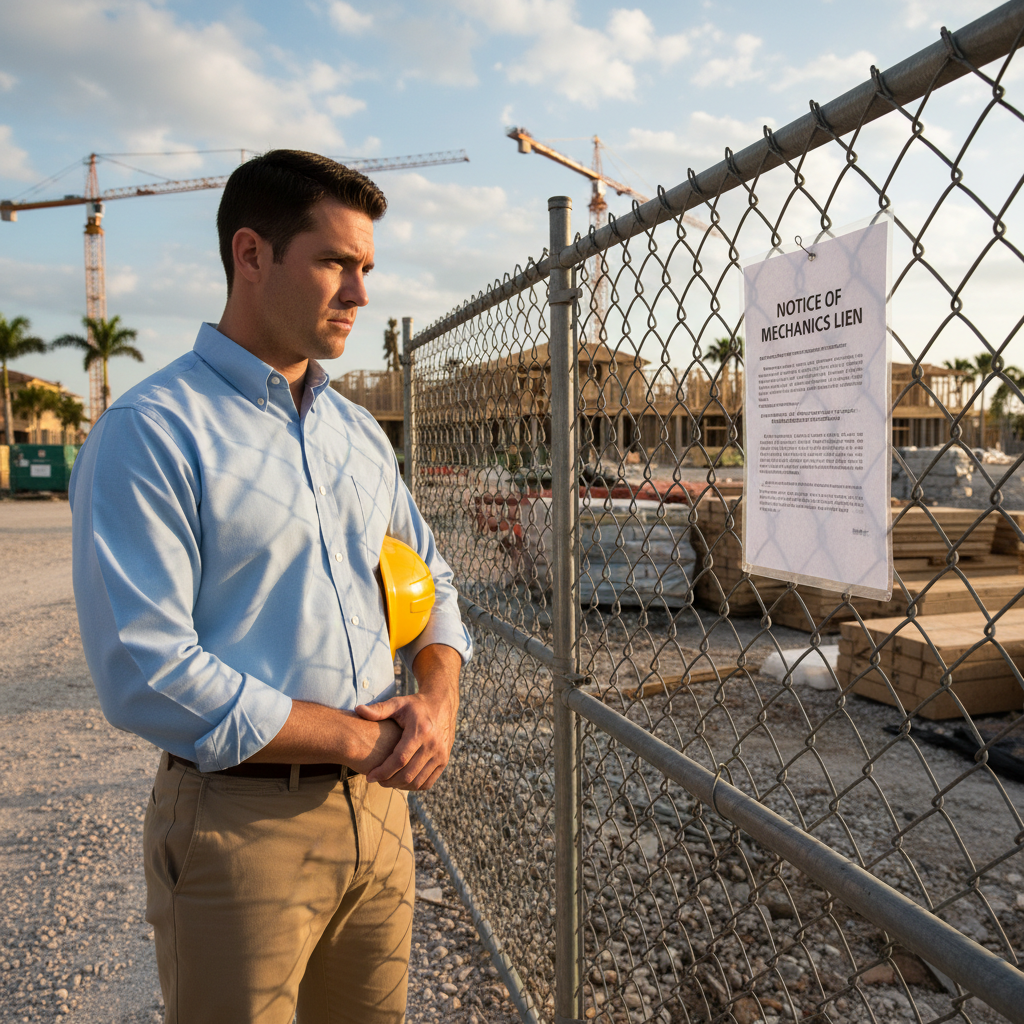
Florida mechanics lien dispute — contractor and property owner

If a mechanics lien in Florida just showed up on your property, you’re probably dealing with a contractor or supplier claiming they weren’t paid — and now your closing is in jeopardy, your lender is calling, and the contractor isn’t returning messages. Disputing a mechanics lien in Florida is absolutely possible, but the process has hard deadlines and specific procedures that can work for you or against you depending on how fast you move. Here’s the practical breakdown of what your options actually are.

Florida’s Construction Lien Law: The Rules That Govern Everything

The Framework Under Chapter 713

Florida’s Construction Lien Law (Chapter 713) governs who can file a lien, what notices are required, and the deadlines for enforcement. It applies to contractors, subcontractors, laborers, and material suppliers. Understanding the requirements is your starting point — because a lien that doesn’t follow them precisely is vulnerable to challenge.

Key Deadlines That Create Your Leverage

  • Notice to Owner: Must be served within 45 days of first furnishing labor or materials. No notice — no lien rights for most subcontractors and suppliers.
  • Lien recording deadline: The lien must be recorded within 90 days of the last day of furnishing labor or materials.
  • Lawsuit deadline: A lien foreclosure action must be filed within 1 year of recording — or the lien is automatically extinguished.

These deadlines are where many liens fail. A Florida construction litigation attorney will check each one as the first step in evaluating your options.

Grounds to Challenge or Discharge a Florida Mechanics Lien

Procedural DefectsFort Lauderdale commercial real estate district — Broward County

These are the most common and most effective challenges. If the liening party missed any procedural step, the lien may be void:

  • Failed to serve a proper Notice to Owner within 45 days of starting work
  • Recorded the lien after the 90-day deadline
  • The lien description of the property or the amount is materially incorrect
  • The contractor had no direct contract with the owner and no qualifying subcontract chain

Substantive Defects

Even if the lien was filed on time and properly noticed, you can still challenge the underlying claim:

  • The lien amount includes work that was never actually performed
  • The work was not authorized by the property owner
  • The owner already paid the general contractor in full and the GC failed to pay the sub
  • The lien was filed as retaliation for a legitimate dispute about quality or scope

Your Three Main Options for Clearing the Lien

Option 1: Transfer the Lien to a Bond

This is often the fastest way to clear title and let a transaction proceed. You post a cash deposit or surety bond equal to the lien amount — plus a premium. The Florida mechanics lien is released from the property and the bond becomes the security for the contractor’s claim. The dispute continues, but your closing or refinance can move forward. A Florida real estate litigation attorney can have this in place within days when a closing is on the line.

Option 2: Demand to Commence Action

Under Chapter 713, you can serve a written demand on the lien claimant requiring them to file a lien foreclosure lawsuit within 60 days. If they don’t file, the lien is extinguished by operation of law — no court order needed. This is an often underused tool. Many lien claimants record liens as a pressure tactic but have no real intention of filing suit. The demand forces their hand.

Option 3: Show Cause Motion

File a motion in circuit court asking the lien claimant to show cause why the lien should not be discharged. The court sets a hearing, and the claimant must demonstrate they have a valid, enforceable lien. If they can’t — or if the procedural defects are clear — the court discharges it. Florida courts can also award attorney fees to the property owner when a lien was fraudulently filed. See the fraudulent lien provision at § 713.31 for specifics.

What Happens If the Lien Is Valid

The Owner Paid the GC — But the Sub Didn’t Get Paid

This is the situation that surprises the most property owners. You paid your general contractor in full. The GC failed to pay their subcontractor. The sub files a lien against your property — and in Florida, it may be enforceable even though you’ve already paid. This is exactly why Florida law requires a Notice to Owner system — it lets owners know who is on the job so they can verify payment before releasing final funds to the GC.

Frequently Asked Questions

Question Answer
Can a subcontractor lien my Florida property if I already paid the GC? Yes — if they properly served a Notice to Owner and recorded timely. Paying the GC doesn’t automatically protect you from sub-contractor liens.
Can I recover attorney fees in a Florida lien dispute? Yes. Chapter 713 allows prevailing party attorney fee awards in lien foreclosure actions. Fraudulently filed liens can also trigger fee awards.
What if the contractor abandoned the job mid-project? Abandonment can affect the validity of the lien. If the contractor walked off without justification, that’s a material factor in your challenge.

A Florida Mechanics Lien on Your Property Needs to Be Addressed Now

Sitting on a Florida mechanics lien while a closing or refinance waits is one of the most expensive things you can do. Feinstein Law handles construction lien disputes and real estate litigation throughout South Florida. Call (954) 767-9662 or visit our contact page.

About Feinstein Law: Feinstein Law is a Fort Lauderdale firm handling construction litigation, real estate disputes, and contract matters throughout Broward, Miami-Dade, and Palm Beach counties.

By : Michael Feinstein | April 11, 2026 | Construction Litigation

Luxury Real Estate Purchase Agreements: Key Clauses to Review

Luxury real estate purchase agreement review — key contract clauses

If you’re buying a luxury home in Florida and you’re about to sign a purchase agreement, the clauses in that contract will determine what happens if a defect surfaces after closing, if the seller backs out, if the appraisal comes in low, or if the closing gets delayed. Florida luxury real estate purchase agreements are not form documents you glance at — they’re the legal framework for a transaction that may be the largest financial decision of your life. Here are the clauses that matter most and what they actually mean for you.

Why Luxury Purchase Agreements in Florida Are Different

Higher Stakes Mean Every Word Matters

In a standard residential transaction, contract disputes usually involve deposits in the $5,000–$30,000 range. In Florida luxury real estate, you’re often looking at deposits of $100,000 to $500,000 or more, inspection periods covering complex systems like seawalls and custom automation, and purchase terms that involve 1031 exchanges, entity structures, or seller financing. A single ambiguous clause can cost hundreds of thousands of dollars. Working with a Florida real estate litigation attorney to review your agreement before you sign prevents the litigation that comes after.

FAR/BAR vs. Custom Contract

Many luxury transactions use custom contracts drafted by the seller’s attorney — especially in new construction, developer sales, and off-market deals. These contracts are written to protect the seller and developer. Every deviation from the standard FAR/BAR contract is intentional — and usually not in your favor.

The Key Clauses in a Florida Luxury Purchase Agreement

Inspection Contingency — Your Most Important Protection

The inspection period is the buyer’s primary window to discover and respond to defects. In standard FAR/BAR contracts it defaults to 15 days. In luxury transactions, this often isn’t enough. You’re dealing with:

  • Seawall and dock inspections for waterfront property
  • Roof inspections on complex tile and flat roof systems
  • Custom automation, smart home, and HVAC system evaluations
  • Pool, spa, and outdoor kitchen equipment assessments
  • HOA and CDD document review requiring their own timeline

Negotiate for 21–30 days minimum on a luxury property. Once the inspection period expires without proper written cancellation, your right to exit without forfeiting your deposit is gone — and you may be in breach of the Florida purchase contract.

AS-IS Rider — What It Does and Doesn’t Mean

Most Florida luxury transactions use the AS-IS rider. Buyers sometimes think this means the seller has no disclosure obligation. That’s wrong. Florida’s disclosure duty from Johnson v. Davis still applies — sellers must disclose known material defects that aren’t readily observable regardless of AS-IS language. What the AS-IS rider actually eliminates is the buyer’s right to demand repairs after the inspection. You can still cancel based on inspection findings — but you can’t force the seller to fix anything. That distinction matters enormously when you discover a $200,000 seawall repair mid-transaction.

Liquidated Damages Clause

This clause defines what happens to the deposit if one party defaults. In a standard FAR/BAR contract, it can be checked two ways:

  • Liquidated damages checked: Seller’s sole remedy for buyer default is keeping the deposit — they can’t sue for more
  • Liquidated damages NOT checked: Seller can pursue actual damages beyond the deposit amount, including loss of a better deal

On a $3 million luxury sale, this distinction can mean the difference between losing a $150,000 deposit or facing a $300,000 damages lawsuit. Know which box is checked before you sign.

Financing Contingency — Don’t Waive It Without Understanding It

What a Proper Financing Contingency Does

A financing contingency protects your deposit if your loan application is denied despite good faith efforts. In today’s luxury market — where jumbo loan underwriting can be rigorous and rates volatile — waiving this contingency entirely is a significant risk. Some buyers waive it to be competitive in a multiple-offer situation, which is a legitimate strategy — but only if you genuinely have cash or ironclad financing in place. The CFPB’s guidance on financing contingencies explains how lenders and buyers should handle these provisions.

Personal Property, Fixtures, and What Conveys

Disputes That Happen After Every Luxury Closing

Item Default Rule What to Do
Light fixtures Typically convey unless excluded Specifically list any seller wants to keep
Smart home equipment Often disputed — is it a fixture or personal property? List every system specifically in the contract
Custom window treatments Depends on how they’re installed Explicitly include or exclude in writing
Outdoor furniture Personal property — does NOT convey unless listed Negotiate inclusion if you want it
Wine collection Personal property Never conveys without specific contract language
South Florida luxury waterfront real estate property — high asset real estate disputeLuxury purchase agreements carry higher stakes — every clause deserves careful legal scrutiny.

Frequently Asked Questions

Question Answer
Can I get my deposit back on a luxury AS-IS purchase in Florida? Yes — if you properly cancel within the inspection period. Once that window closes, the AS-IS nature of the sale makes deposit recovery much harder without proving seller fraud or breach.
Do I need an attorney to review my luxury purchase agreement? Not legally required — but practically essential on transactions of this size. The cost of a contract review is trivial compared to what a bad clause can cost you.
Can a Florida luxury seller back out after accepting my offer? Only with legal justification. Backing out without cause makes the seller the defaulting party — and you can pursue specific performance or damages including your deposit plus costs.

Review Your Florida Luxury Purchase Agreement Before You Sign — Not After

Feinstein Law reviews and negotiates Florida luxury real estate purchase agreements and handles post-closing disputes for buyers and sellers throughout South Florida. Call (954) 767-9662 or contact us at our contact page.

About Feinstein Law: Feinstein Law is a Fort Lauderdale firm focused on real estate litigation, contract disputes, and business law throughout Broward, Miami-Dade, and Palm Beach counties.

By : Michael Feinstein | April 10, 2026 | Real Estate Contracts

Florida Breach of Fiduciary Duty: What Business Owners Need to Know

Florida breach of fiduciary duty — business litigation attorney

If you’re a business owner in Florida and you suspect a partner, officer, or manager has been working against the company — quietly taking deals, draining accounts, or feeding customers to a competitor — you’re dealing with what the law calls a breach of fiduciary duty in Florida. It’s one of the most serious claims one business stakeholder can bring against another, and it carries real teeth. Fiduciary duty violations in Florida can result in damages, disgorgement of profits, removal from the company, and in the right circumstances, injunctive relief that stops the harm immediately. Here’s what you need to know.

What a Fiduciary Duty Actually Requires

The Highest Standard in the Law

A fiduciary duty is not just an ethical expectation — it’s a legally enforceable obligation to put the interests of the company or the other stakeholders above your own. In Florida business law, this duty applies to several relationships. Under Florida’s Business Corporation Act (Chapter 607), corporate officers and directors owe duties of care and loyalty to the corporation and its shareholders. LLC managers owe similar duties under Florida’s LLC Act (Chapter 605). Partners owe each other fiduciary duties under Chapter 620.

Who Owes a Fiduciary Duty in Florida Business?

  • Corporate officers and directors — to the corporation and its shareholders
  • LLC managers and managing members — to the LLC and its members
  • General partners — to each other and the partnership
  • Attorneys, accountants, financial advisors — to their clients
  • Majority shareholders — to minority shareholders in closely held corporations

What Breach of Fiduciary Duty Actually Looks Like

It’s Usually Not Obvious at FirstFlorida business partner bankruptcy — attorney reviewing documents

You’re probably not dealing with someone who walked out with a bag of cash. Fiduciary duty breaches in Florida are usually more subtle — and that’s by design. The people who do this know what they’re doing. Common patterns include:

  • Self-dealing — approving transactions that benefit themselves at the company’s expense
  • Usurping corporate opportunities — taking a business deal for themselves that should have gone to the company
  • Competing directly against the company while still in a management role
  • Misappropriating funds — unauthorized distributions, expense fraud, or diverting payments
  • Providing false financials to partners or investors to conceal losses or self-dealing
  • Failing to disclose conflicts before making decisions on the company’s behalf

If you’re seeing unexplained financial discrepancies, deals that never materialized, or a manager who suddenly left to start a competing business — those are signals. A Florida business litigation attorney can help you start building a record before you tip your hand.

What You Have to Prove in Court

The Four Elements

Element What It Requires
Fiduciary relationship existed The defendant owed a duty to the plaintiff or the company — not just any business relationship qualifies
Breach of that duty The defendant acted in a way that violated loyalty, care, or good faith obligations
Causation The breach directly caused harm — not just that the defendant did something wrong
Damages Actual, quantifiable financial loss resulting from the breach


Florida business owner discovering breach of fiduciary duty in company financials

The Business Judgment Rule — Their Defense

Expect the defendant to invoke the business judgment rule. Under Florida Statute § 607.0830, courts won’t second-guess business decisions made in good faith, with reasonable care, in the company’s best interest. This is a real defense — it protects honest mistakes. What it doesn’t protect is self-dealing, fraud, or decisions made to benefit themselves over the company. The line between a bad business decision and a breach of duty is where most of the litigation happens in a Florida business dispute.

Remedies Florida Courts Can Award

It’s Not Just About Getting Your Money Back

Remedy What It Covers
Compensatory damages Financial losses the company or plaintiff suffered directly from the breach
Disgorgement Profits the fiduciary gained from the breach — even if the company suffered no matching loss
Injunctive relief Emergency order to stop ongoing harm — blocking access to accounts or client data
Judicial dissolution or buyout In severe cases, courts can order the company dissolved or force a buyout of the breaching party
Attorney fees Available when the breach involved fraud or particularly bad conduct
Early discovery of fiduciary breaches is critical — delay can weaken damages claims.

Frequently Asked Questions

Question Answer
Can a minority shareholder sue for breach of fiduciary duty in Florida? Yes. Minority shareholders can bring derivative claims on behalf of the corporation or direct claims when majority shareholders breach duties owed to them personally.
How long do I have to file in Florida? Generally 4 years from discovery of the breach under Florida’s statute of limitations — but the clock can be tricky when the breach was concealed.
Can I remove a partner who breached their fiduciary duty? Possibly. Florida courts can order expulsion or a forced buyout in severe cases, particularly when the operating or partnership agreement permits it.
Do I need to show the company lost money? Not always. Disgorgement of profits the fiduciary gained — even without a matching company loss — is available under Florida law.

When a Partner Violates Your Trust, Florida Law Has a Remedy

Waiting gives a disloyal partner or officer more time to cause damage and cover their tracks. Feinstein Law handles breach of fiduciary duty cases and complex Florida business litigation for owners who need to act fast. Call (954) 767-9662 or contact us at our contact page.

About Feinstein Law: Feinstein Law is a Fort Lauderdale litigation firm serving clients in business, real estate, and contract disputes throughout Broward, Miami-Dade, and Palm Beach counties.

By : Michael Feinstein | April 10, 2026 | Business Litigation
Call Now